

Product descriptions play a bigger role in ecommerce growth than many teams realize. As shoppers turn to AI agents to discover products, descriptions become even more important.
They shape how people understand an item, influence conversions, and affect how often products surface in search engines and AI shopping assistants.
With larger catalogs and rising content demands, AI has become a practical way to write, refresh, and scale descriptions without slowing down launches.
But not all AI tools work the same. Some are great for early drafts. Some help refine tone and clarity. Others are built for ecommerce and use structured data, specs, and attributes to generate accurate, ready-to-publish descriptions at scale.
This guide covers:
- What makes a good AI tool for product descriptions
- The top AI tools for product descriptions
- How to choose the right AI tool for your needs
What makes a good AI tool for product descriptions
There are many AI tools today that can write on command. Enter a prompt and you’ll get a description in seconds.
But product descriptions are more than words on a page. They need to reflect attributes, follow workflows, and fit into the systems that manage your catalog.
Here are some points to consider when choosing an AI tool for your product descriptions.
- Understands product attributes, variants, and use cases: It should interpret specs, materials, and technical details, then express them as clear benefits and use-case context.
- Keeps tone consistent and follows brand or regulatory guidelines: Descriptions need to stay aligned with your approved terminology, voice, and any compliance rules.
- Supports SEO and GEO: The tool should weave in relevant keywords, adapt content for different markets, and stay readable for both search and AI-led discovery.
- Fits into existing ecommerce workflows: Integrations with your PIM, DAM, Shopify, or other systems help teams produce and publish content without extra steps.
- Handles scale across thousands or millions of SKUs: It must reliably generate complete, consistent descriptions in bulk so large catalogs can launch or update quickly.
The top AI tools for product descriptions
Hypotenuse AI
Hypotenuse AI is an AI platform built for ecommerce teams that need complete, accurate product descriptions at scale. It doesn’t just create descriptions. It can fill missing attributes, fix data errors, and turn clean structured data into SEO- and GEO-optimized copy written in your brand voice.
It also supports translations in more than 40 languages and can publish updated product content to your sales channels and marketplaces as part of your workflow.
Best for
Ecommerce brands with large or fast-changing catalogs that need consistent, enriched descriptions across thousands of SKUs.
Pros
- Generates complete descriptions from unstructured data and attributes
- Produces consistent copy in your brand voice across the entire catalog
- Supports SEO, GEO, and multi-language content
- Handles bulk edits and translations smoothly
- Fits into ecommerce workflows through PIM, DAM, and storefront integrations, and can also function as your PIM and DAM
Limitations
- Requires some onboarding and workflow setup to get the most out of integrations and governance features
Jasper
Jasper is a marketing-focused AI writing tool designed for brand voice consistency across blogs, ads, landing pages, and social content. While it wasn’t built specifically for ecommerce, teams often use it to create persuasive or styled product description drafts.
Best for
Marketing teams that want branded, high-level product descriptions rather than attribute-heavy or highly structured copy.
Pros
- Provides controls to match a chosen tone or style when writing product descriptions
- Good for adapting descriptions for campaigns or seasonal messaging
- Useful templates for creating marketing copy
- Fast for generating first-draft copy or trying out different angles
Limitations
- Not designed for detailed product attributes, specs, or variants
- No structured ecommerce or product-data integrations
Shopify Magic
Shopify Magic is Shopify’s built-in AI writing tool that generates simple product descriptions during product upload. It focuses on creating quick, readable copy based on the keywords and product features you provide. You can also use it to edit existing descriptions by simplifying, rephrasing, or expanding the text.
Best for
Small to medium Shopify stores that want fast, lightweight descriptions without needing complex workflows or structured product data.
Pros
- Native to Shopify, with no setup or integration needed
- Generates quick, easy-to-read descriptions for new products
- Useful for making fast edits to existing descriptions
- Keeps the workflow simple with a familiar interface and no extra accounts or tools
Limitations
- Limited control over tone, structure, and compliance requirements
- Only works within Shopify, with no integrations into broader ecommerce workflows or marketplaces
Grammarly
Grammarly is a writing assistant that improves clarity, tone, and correctness. While it doesn’t generate product descriptions, it’s often used to refine existing copy, making descriptions easier to read and more consistent across a catalog.
Best for
Teams that already have product descriptions drafted and want to polish them for clarity, tone, and readability.
Pros
- Improves clarity and flow of existing product descriptions
- Adjusts tone to match the level of formality you want
- Helps catch grammar, spelling, and phrasing issues
- Works across browsers, documents, and content tools your team already uses
Limitations
- Not suited for detailed or technical product content that needs attribute accuracy
- No support for catalog-scale workflows, enrichment, or bulk updates
Amazon’s native AI writer
Amazon’s native AI writer helps sellers create product descriptions, titles, and bullet points directly within Seller Central. It generates listing content based on the information provided by the seller and formats it to align with Amazon’s listing standards.
Best for
Amazon sellers who want a quick way to produce or update listing copy that follows Amazon’s structure and requirements.
Pros
- Generates titles, bullets, and descriptions quickly
- Produces content that matches Amazon’s preferred formatting
- Improves listing quality without relying on external tools
- Reduces manual writing for sellers managing many SKUs
Limitations
- Only works for Amazon listings and doesn’t support omnichannel content
- Accuracy depends on the information provided by the seller
ChatGPT
ChatGPT is a general-purpose AI model that can generate product descriptions from prompts, interpret technical details, and help you brainstorm benefits, use cases, and angles for your product pages. It isn’t built specifically for ecommerce workflows but is often used for early drafts or idea exploration.
Best for
Teams that want flexible first drafts, brainstorming support, or help turning raw notes into readable product descriptions.
Pros
- Highly adaptable to different writing styles and tones
- Good at turning rough notes or specs into clear, readable descriptions
- Useful for brainstorming benefits, FAQs, or alternative angles
- Works well for one-off descriptions or early-stage drafts
Limitations
- Not built for ecommerce workflows, catalog updates, or structured product data
- Can follow brand voice instructions in a prompt, but cannot be trained on a brand’s guidelines in a persistent or model-level way
How to choose the right AI tool
Different tools serve different parts of the product-description workflow. Here’s a simple way to decide which one fits your needs:
- If you need structured data accuracy and full catalog workflows: Hypotenuse AI is best for turning attributes, variants, and large catalogs into complete, consistent descriptions.
- If you want general marketing copy: Jasper works well for promotional descriptions or campaign-driven product blurbs.
- If you want fast rewriting: Grammarly helps refine existing descriptions for clarity, tone, and readability.
- If you need quick Shopify edits: Shopify Magic is a good fit for simple, fast descriptions created directly during product upload.
- If you’re listing on Amazon: Amazon’s native AI writer generates Amazon-formatted bullets and descriptions inside Seller Central.
- If you need rough drafts or brainstorming: ChatGPT is helpful for early ideas, first drafts, or interpreting raw notes into readable copy.
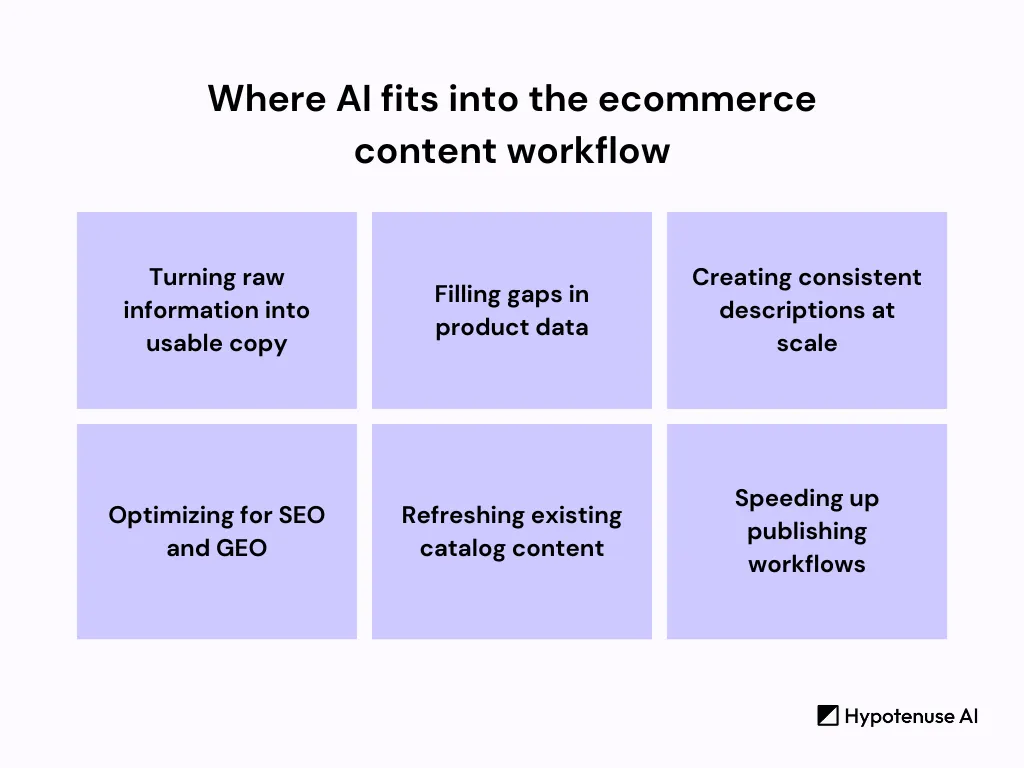
Where AI fits into the ecommerce content workflow
AI supports more than just the writing step. It can help throughout the entire product-content lifecycle, especially as catalogs grow and new products launch.
Turning raw information into usable copy
AI can take product notes, specs, attributes, or early-stage details and turn them into clear descriptions, even when information comes in unstructured formats.
Filling gaps in product data
Missing attributes or inconsistent details often delay product launches. AI helps identify gaps and generate complete, accurate information before descriptions are written.
Creating consistent descriptions at scale
Large catalogs need alignment across tone, structure, and terminology. AI helps teams generate product descriptions that feel consistent across thousands of SKUs and variants.
Optimizing for SEO and GEO
AI can adapt descriptions for different markets, keywords, and search behavior to help products surface across search engines and AI-assisted shopping tools.
Refreshing existing catalog content
When older descriptions feel outdated or incomplete, AI can rewrite or expand them so they better match today’s products, campaigns, and standards.
Speeding up publishing workflows
Once descriptions and attributes are ready, AI can help prepare content for different sales channels and marketplaces, reducing manual steps and handoffs.
Conclusion
AI has made product description workflows faster and more scalable, but not every tool serves the same purpose.
Choosing the right tool depends on how your team works, how complex your products are, and how many SKUs you manage. With the right setup, AI can support everything from filling data gaps to writing descriptions, refreshing older content, and preparing information for different sales channels.
The goal isn’t just to generate copy. It’s to create consistent, accurate product descriptions that help shoppers understand your products and make confident decisions.


.avif)