

AI-assisted shopping has been moving fast. What started as simple product suggestions inside AI chats has now grown into something much more capable, able to surface thoughtful recommendations instead of loose guesses.
The basic shopping features rolled out earlier this year. Since then, we’ve seen more, like payment integrations with PayPal and Stripe that enable instant checkouts, make the flow more secure, and give shoppers more confidence buying through AI.
And just last week, ChatGPT upgraded those capabilities with Shopping Research.
This article breaks down what ChatGPT Shopping Research does, how it performs in real use, and what this shift toward AI-assisted shopping means for ecommerce brands.
What ChatGPT Shopping Research does
First, what’s the difference between ChatGPT Shopping and Shopping Research?
ChatGPT Shopping gives quick recommendations based on your query. If your question shows shopping intent, ChatGPT switches into shopping mode and suggests ideas or specific items you can buy directly through the platform.
Shopping Research goes much deeper. It searches the web for products, lays out pros, constraints, and tradeoffs, and explains why a product might be right for you, or why it might not be. After a few recommendations, it even helps you weigh them by surfacing the situations where each option makes sense.
Here’s how it works:
1. Open the dedicated feature from the + menu and ask a shopping question.

2. ChatGPT asks a few follow-up questions to personalise the recommendations, usually in multiple-choice form.

3. As it searches, it shows early options that you can react to or refine.
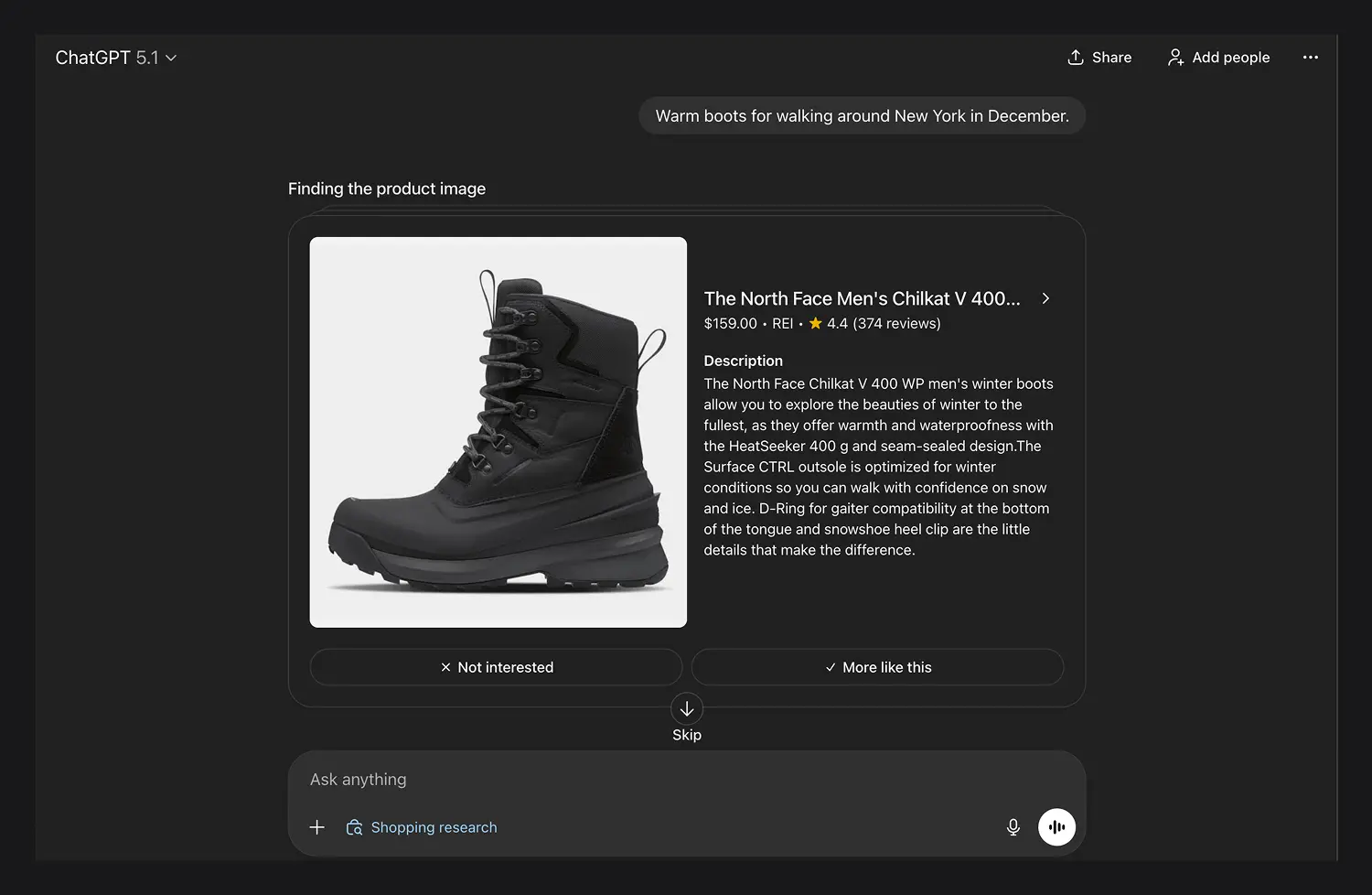
4. It continues scanning PDPs, product roundups, and community discussions to curate a final set of options with pros, cons, and key decision factors. It also gives you the best overall for when you just can’t decide.
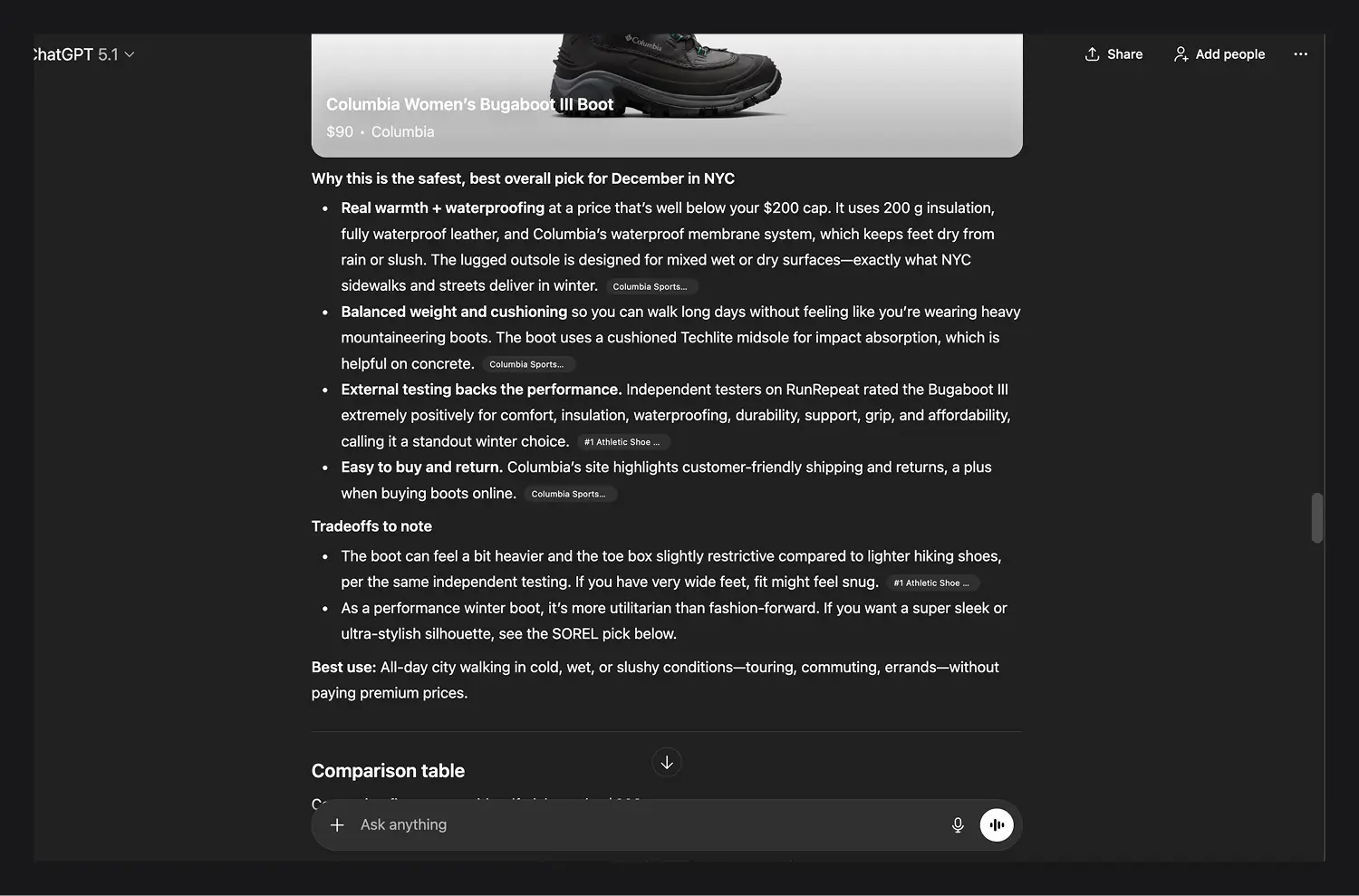
We tested ChatGPT Shopping Research and here’s what we found
To get a clearer sense of how well Shopping Research actually works, we ran a small set of tests across different types of queries.
Instead of trying everything, we focused on five areas that give a good read on its strengths and gaps.
These cover how well it understands intent and constraints, how it handles comparisons and decision-making, and how accurate it is with real-world details.
1. Needs-based queries
For this test, we looked at how well Shopping Research handles prompts where the shopper doesn’t have a specific product in mind yet, only a scenario.
Example we tested:
“Warm boots for walking around New York in December.”
This required the AI to first understand the weather and general conditions in New York, then look for products with attributes that match that scenario. It needed to consider warmth, comfort, traction, and long-distance walking before curating suitable options.
On the first try, it didn’t consider gender and recommended a mix of men’s and women’s boots.
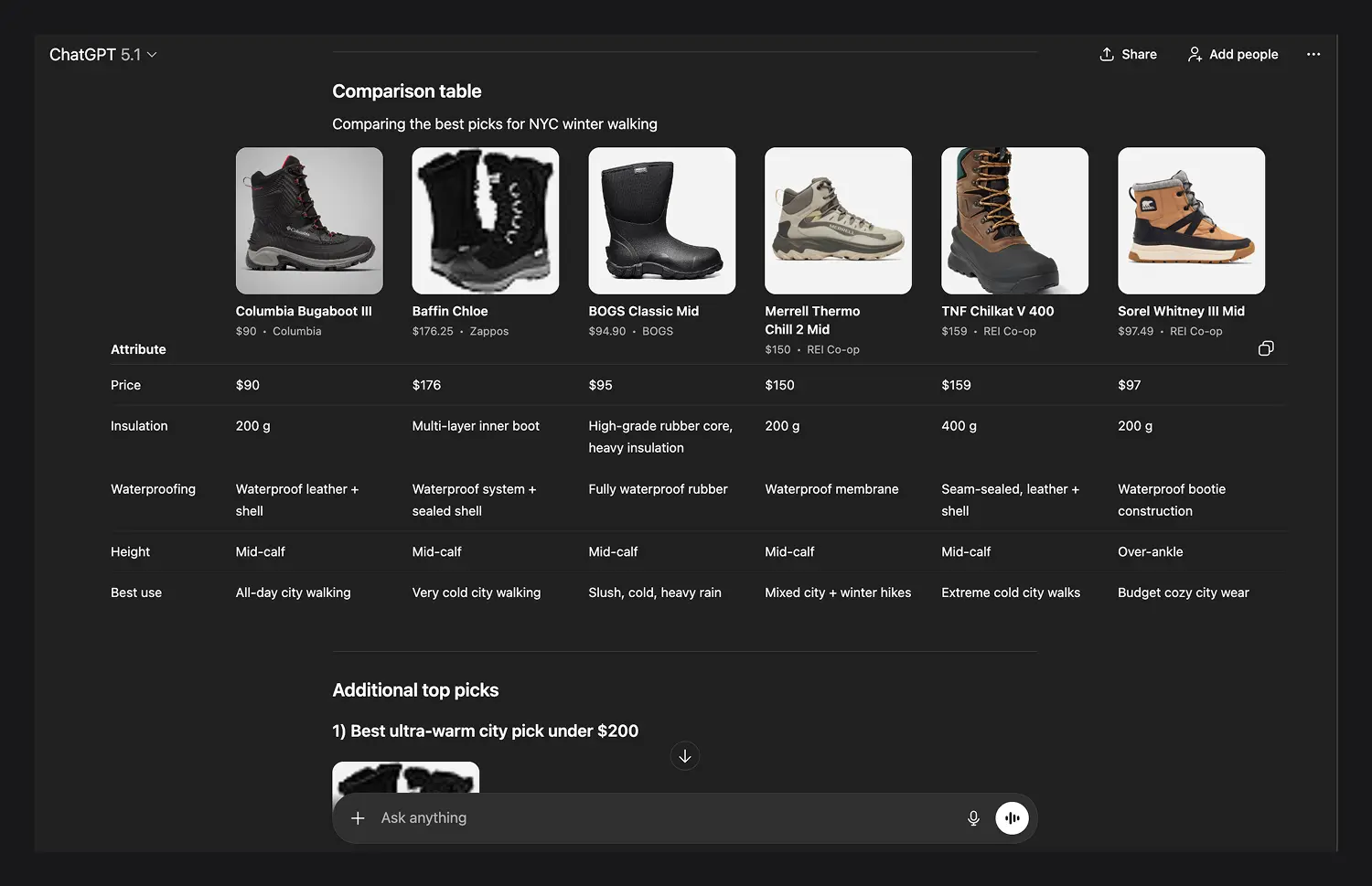
After specifying gender, it refreshed the list with five options, including a best pick.
The recommendations were good-quality choices. However, the styles varied a lot — from casual winter boots to more rugged hiking-oriented ones. It could have asked clarifying questions to narrow down the intended use. Someone going to NYC for hikes would need a very different boot than someone visiting museums and cafes.
2. Constraint-heavy prompts
With a broader, open-ended query, Shopping Research didn’t perform well. It didn’t know which questions to ask and struggled to arrive at strong options.
So we tried adding constraints around budget, size, comfort, material, and specific features to help guide the AI.
Example we tested:
“A backpack under 1kg with a laptop sleeve, under $150.”
With clear constraints, it fared better. The recommendations met all the requirements, and it also pre-emptively addressed potential objections.
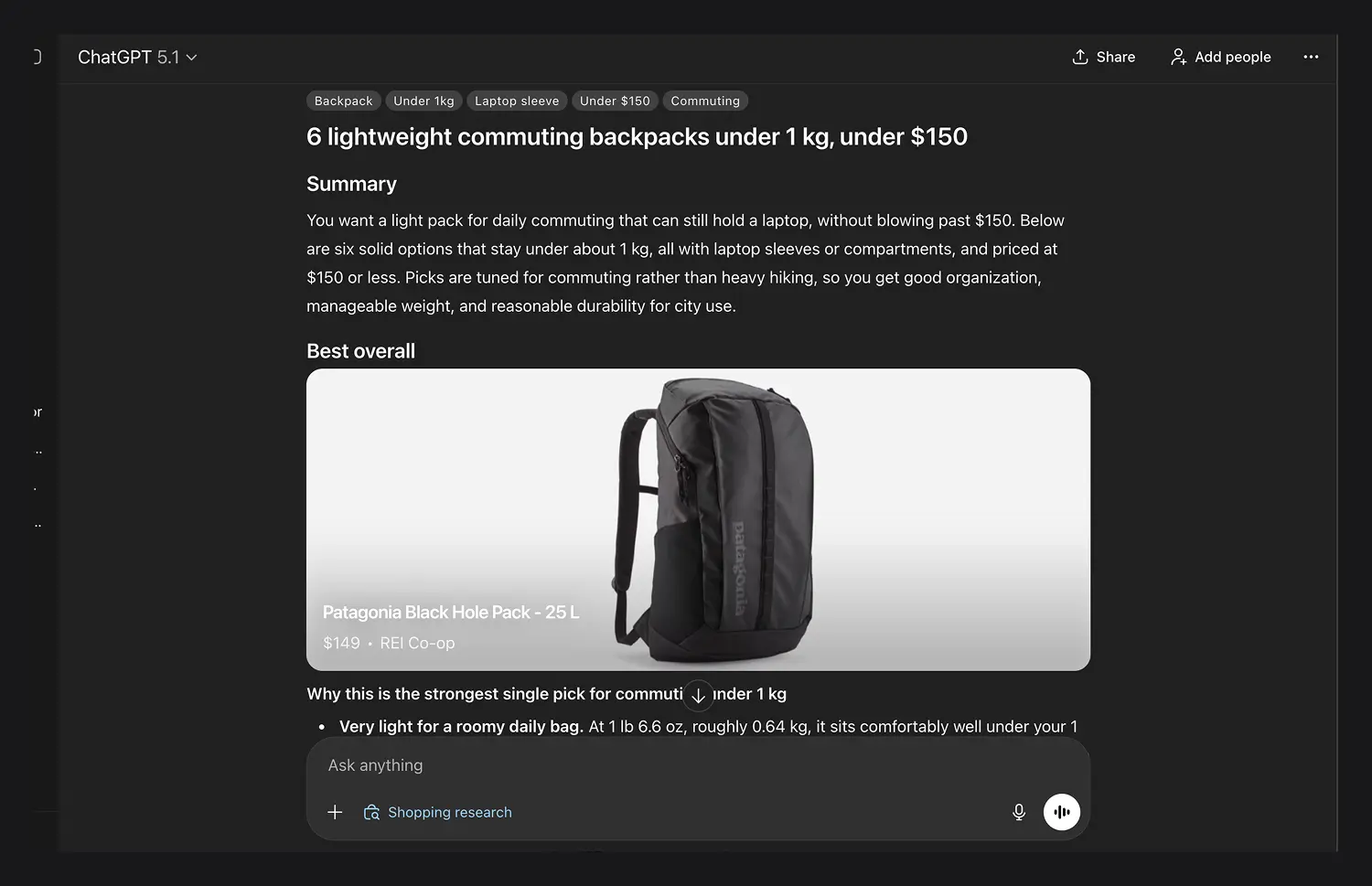
It recognized that asking for a 1kg bag implies wanting something lightweight, and highlighted the tradeoffs that come with that. Less room, less structure, and a softer frame that makes packing a bit trickier.
It also linked its recommendations back to the use case. When asked, I mentioned the backpack was for commuting, and it adjusted its reasoning accordingly.
3. Decision-making guidance
After filtering and shortlisting products, the next question is whether Shopping Research can actually guide you toward a choice and help you feel confident making it.
Example we tested:
“Help me decide between all these if I want warmth over price.”
We went back to the options from point 1 and asked ChatGPT to compare them again based on one factor: warmth.
The results were strong. Instead of giving absolutes like “this is the warmest,” it offered detailed reasoning that showed it understood different types of insulation and how they perform in winter conditions.

It painted clear scenarios and matched each product to when it would make sense. It also described warmth in practical terms. For example, explaining that 400 g insulation is built for proper winter, that neoprene combined with a rubber shell traps heat well in very low temperatures, and that certain boots are warm enough for city walking when paired with good socks.
This level of explanation helps shoppers visualize how each product fits real conditions, rather than just relying on technical specs.
4. Comparison requests
We later zoomed out and asked it to compare two products side by side.
Example we tested:
“Compare the Sony WH-1000XM5 and Bose QC Ultra.”
The regular ChatGPT can do basic comparisons too, so we wanted to see if Shopping Research actually adds anything.
At first glance, the biggest difference is the comparison table. Shopping Research uses more relatable language that ties back to real usage, such as “Light, comfortable for long use, but the case is bulkier and the design is mostly plastic.” The regular mode uses vague phrases like “acceptable” or “a little more comfortable,” which don’t give a helpful point of reference.
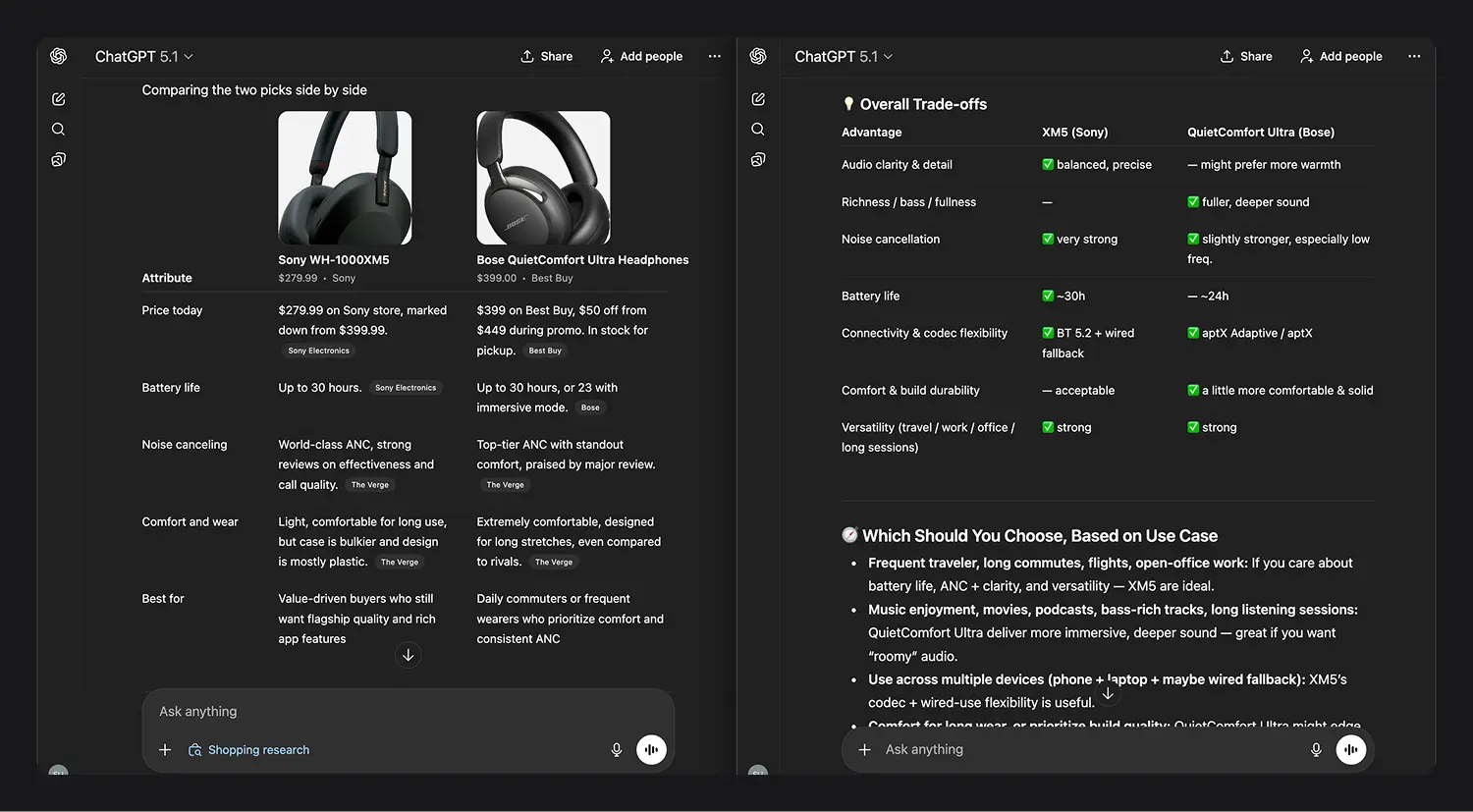
Looking deeper, both modes surface similar factual details, but Shopping Research adds more live data like prices and discounts. It also brings in more human considerations, such as whether someone cares about materials or sustainability if a product uses more plastic.
The regular mode mostly lists features and basic pros and cons without linking them back to situations or use cases. It feels descriptive, while Shopping Research feels more practical for someone trying to decide what to buy.
5. Real-world accuracy
To see how well Shopping Research stays grounded in real-world information, we tested prompts that depend on live details like pricing, stock, and availability.
Example we tested:
“Which of these is in stock now?”
Shopping Research performed well here. It surfaced updated prices, delivery timelines, pickup options, and whether an item was currently discounted.

Another example we tested:
“Where can I buy these at the lowest prices?”

With a quick Google search, this seemed accurate. What stood out most was that it recommended buying from Bose’s brand website and explained that even though the price there was slightly higher, the out-of-pocket cost is almost identical to the cheapest option, and fulfillment is simpler.
This mirrors how many shoppers weigh the tradeoff between convenience and small price differences, and the answer felt practical rather than random.
Overall: What Shopping Research does well (and where it struggles)
How it differs from regular ChatGPT Shopping
Compared to regular ChatGPT Shopping, which surfaces quick picks from multiple stores, Shopping Research feels more deliberate.
It looks at individual PDPs (often a lot of them) on top of community threads and review sites before curating a single recommended option from a single store. The result feels less transactional and more like guided advice with context.
What it’s good at
- Strong with constraints. Performs best when the prompt includes budget, size, features, or a clear use case.
- Detailed, scenario-based reasoning. Explains tradeoffs, materials, insulation, comfort, and usage in ways that match real-world needs.
- Decision-making support. Helps you understand when a product makes sense and why.
- Accurate real-time data. Often includes availability, delivery timelines, pickup options, and return policies.
What it’s not so good at
- Weak with open-ended prompts. Does not always ask clarifying questions, so results can span across very different product types.
- Occasional misalignment. For example, it marked an item as out of stock even though a few sizes were still available.

The shift towards AI-assisted shopping
Across the tests, one thing stood out. Shopping Research fits into a broader shift where AI is starting to shape how people discover and choose products. A few patterns are becoming clear.
AI is becoming a product selector and pre-filter.
Shoppers no longer need to scroll through pages of products. They describe what they need and let the AI filter options, apply constraints, and narrow the list to a manageable set. This moves the first layer of product discovery away from traditional search results.
Discovery is becoming conversational.
People are using fewer keywords and more natural, scenario-driven prompts. Instead of typing something broad like “winter boots,” they ask for “warm boots for walking around New York in December.” The AI interprets intent, conditions, and preferences and responds with options that match the situation rather than the keyword.
Trust is rising with secure payments.
With PayPal, Stripe, and other checkout flows integrated into AI platforms, shoppers feel more comfortable buying through an AI interface. What used to feel experimental now feels familiar and supported by trusted payment providers.
Auto-buy based on pricing is emerging.
Amazon and Google now support features where shoppers can set a target price and let the system complete the purchase automatically when it drops. It turns price watching into an automated workflow where shoppers define the rule and the system handles the rest.
Replenishment nudges are becoming more common.
Retailers already do this today. Amazon prompts shoppers to reorder essentials based on past purchase cycles, and Instacart suggests weekly staples based on household patterns. With AI, these nudges become easier to automate and more personalized, so shoppers restock through timely suggestions rather than manual decisions.
What ChatGPT Shopping Research and AI-assisted shopping means for ecommerce brands
As AI tools play a larger role in how shoppers browse and make decisions, there are 2 points ecommerce brands should think about: whether they show up, as well as how and when they do.
This comes down to a few things:
1. Complete and consistent product data
AI needs full attribute coverage, clear measurements, variant details, and accurate categorization to understand what a product is and when it fits a shopper’s scenario. Missing or inconsistent data reduces the chance of being surfaced.
2. Standardized structure across the catalog
Titles, attributes, units, colors, and variant naming should follow a consistent pattern. Data standardization helps AI compare products and interpret them correctly.
3. Content that aligns with real use cases
Shoppers describe situations, not keywords. PDPs and product descriptions should reflect the scenarios a product solves. This includes high-quality descriptions that explain how the product is used, use-case aligned bullets, comparison-ready specs, and FAQs that answer decision-making questions.
4. High-quality images that support multimodal search
Clear angles, consistent backgrounds, lifestyle photography, scale references, and variant clarity help AI interpret the visual aspects of a product more accurately.
5. Strong off-page signals
AI pulls from review sites, buying guides, roundups, community threads, and third-party retailers. Consistent information and wider coverage improve visibility across AI-led shopping tools.
6. Accurate availability, pricing, and regional signals
AI checks who has stock, who ships to a specific region, and who offers reliable delivery. Prices, availability, and regional data should stay accurate and up to date to avoid losing visibility to other retailers.
7. Content that goes deeper than the PDP
In-depth blog articles, buying guides, and how-to-choose content strengthen AI’s understanding of when a product is right for a specific situation. These pages give the model more context and help it justify recommendations.
Conclusion
ChatGPT Shopping Research highlights how important clean product data has become. Brands with complete attributes, a standardised catalog, use-case aligned content, and strong images are far more likely to be understood and recommended by AI systems. This is where Hypotenuse AI supports ecommerce teams day to day.
Off-page signals, regional accuracy, and deeper educational content remain important too. All of these pieces work together to influence when and where a product is surfaced in an AI-led shopping journey.





.avif)