

AI has sped up content creation for ecommerce. Brands and distributors once went live without full descriptions or detail bullets. That was acceptable when content took weeks to produce.
With AI now everywhere, high-quality PDP copy has become the baseline. Sites that lack it not only convert poorly, they also risk losing visibility on AI-driven search engines.
The question is no longer “Should I use AI?” It’s “How do we ensure every line stays consistent, accurate, and compliant?”
This article breaks down:
- The three pillars of high-quality product copy
- Common points of misalignment when using AI
- Steps to govern AI-generated content
- How AI writes product copy without inventing specs or claims
The three pillars of high-quality AI product copy
AI can generate copy fast, but quality depends on the foundations you put in place. You don’t want just words on a PDP. Or even generic, fluent copy.
Strong product content sits on three pillars: brand consistency, compliance, and structured data.
Pillar 1: Brand consistency
Great PDPs sound unmistakably like your brand. AI needs clear rules to achieve that.
What this includes:
- Voice and tone guidelines
- Required and banned terms
- Naming rules for products, collections, and variants
- Measurement formats, style conventions, and label phrasing
- Category-specific nuances (eg. how you describe fabrics vs hardware)
Why it matters:
Consistent brand language builds trust, reduces confusion, and improves conversion. Without clear guidance, AI can drift, mixing styles or introducing phrases that don’t fit how your brand speaks.
Pillar 2: Compliance and accuracy
AI should never guess. It needs clear boundaries to stay within legal and category rules. Because if you leave room for ambiguity, AI starts to invent details.
What this includes:
- Ingredient, material, and safety guidelines
- Claims limitations (eg. no medical, fragrance, or exaggerated and unsupported claims)
- Retailer and marketplace requirements
- Regional regulations for formatting, materials, and disclosures
- Internal product naming and packaging rules
Why it matters:
Compliance affects risk. Wrong claims can lead to listing takedowns, regulatory issues, or inconsistent experiences across markets. Guardrails ensure copy stays safe to publish at scale.
Pillar 3: Structured and complete product data
AI performs best when the underlying data is clean. Clean meaning consistent, complete, and accurate.
(This assumes you’re giving AI structured product data to generate copy, not only prompts.)
What this includes:
- Complete attributes
- Standardized taxonomies
- Variant relationships
- Clean, deduplicated data
- Consistent formatting for measurements, materials, and naming
Why it matters:
AI relies on truth from your product data. Missing or inconsistent attributes lead to hallucinations, mismatched details, or copy that varies across SKUs. Structured data ensures accurate and repeatable outputs.
Common points of misalignment when using AI for product copy
Even with strong AI models, product copy can drift when the guardrails aren’t clear. These issues show up most often when brands scale content across thousands of SKUs, multiple markets, and different internal teams.
1. Inconsistent tone and naming
Without explicit rules, AI may switch between styles or label the same product in different ways.
Examples:
- “Crewneck Tee” on one SKU, “Crew Neck T-Shirt” on another
- Mixing casual and formal tone within a single category
- Using adjectives that don’t fit your brand style, like “engineered” for an artisanal brand
This weakens brand perception and creates friction for shoppers who rely on consistent naming to compare products.
2. Incorrect or invented details
When product data is incomplete, AI tries to fill the gaps.
Common issues:
- Guessing materials or dimensions
- Adding benefits the product doesn’t actually offer but are common in similar products
- Misinterpreting technical attributes, such as treating MDF as solid wood
- Filling empty fields with generic statements just to increase word count
This is the fastest path to compliance problems.
3. Claims that break rules
AI doesn’t naturally know which claims are restricted or prohibited. Many retailers and marketplaces enforce strict rules around performance, safety, and ingredient language.
It may:
- Overstate performance or durability, such as calling a water-resistant coat “fully waterproof”
- Imply medical or therapeutic benefits
- Add fragrance or ingredient claims that aren’t allowed
- Describe safety features inaccurately or without certification
Retailers and marketplaces can flag or remove listings for this.
4. Misalignment across markets
AI may produce content that sounds correct but fails regional expectations.
Examples:
- Using the wrong sizing conventions (US vs EU vs AU)
- Formatting measurements in a way that feels unfamiliar
- Using terms that don’t resonate with local shoppers
- Missing disclosures that are required in specific regions
This results in extra manual clean-up before launch. In some cases, pages get flagged or simply fail to convert.
5. Content that ignores category nuance
Each category has its own vocabulary and expectations. Without clear guidance, AI blends these styles together and produces copy that feels generic or out of place for the product.
Examples:
- Using performance language like “engineered airflow” or “moisture control” for non-technical clothing
- Framing a simple moisturizer as if it delivers medical results such as “reduces inflammation” or “treats acne”
- Using lifestyle-driven language for furniture when shoppers expect material and construction details
- Describing industrial products like screws or knobs with aesthetic adjectives that belong in home decor or fashion
6. Outputs that don’t match the product data
Even when data exists, AI may:
- Miss important attributes
- Highlight unimportant ones
- Use attribute names that don’t match your taxonomy
- Create descriptions that contradict variant relationships
This causes confusion and often forces teams to rewrite content manually.
A practical framework for governing AI-generated copy
Good output depends on strong inputs and predictable guardrails. Here’s a framework brands can use to keep AI-generated content consistent, compliant, and ready to publish at scale.
It includes defining your rules, setting up workflows, and maintaining feedback loops to align better over time.
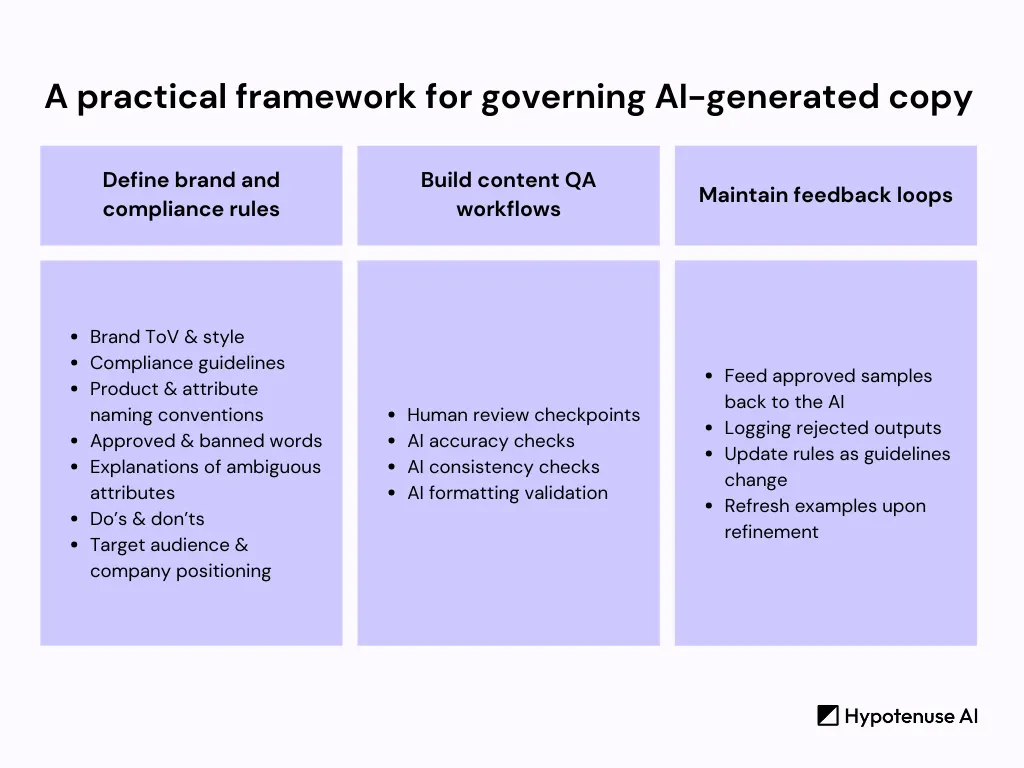
1. Define brand and compliance rules centrally
Create one central source of truth that AI and your team can rely on. This reduces ambiguity and prevents drift.
Include:
- A brand voice checklist with tone, style, and phrasing rules
- Compliance guidelines for each category or region
- Attribute naming conventions for products, variants, and collections
- A clear list of approved and prohibited words, and when to use or avoid them
- Explanations of ambiguous attributes (for example, what “lightweight” means in your context)
- Explicit instructions on what the AI should do and should avoid
- A clear definition of your target audience and your company’s positioning
The more specific the rules, the more stable the outputs. Although, going too specific can make AI stiff and repetitive. Focus on the rules that are factual and critical, rather than trying to define every small thing.
2. Build content QA workflows
Clear rules are the foundation, but they still need checks. Set up lightweight workflows that catch issues before content goes live.
Include:
- Human review checkpoints for high-risk categories or new collections
- Automated accuracy checks against product data to prevent wrong materials, claims, or dimensions
- Consistency checks across SKUs, variants, and categories
- Formatting validation to ensure measurements, naming, and tone stay aligned with your standards
A good QA workflow doesn’t slow teams down. It helps you catch drift early so AI output stays reliable at scale.
3. Maintain feedback loops
Just like humans need alignment and reinforcement, AI is unlikely to get everything right the first time. It improves and aligns better over time when you show it what “good” looks like.
Include:
- Feeding approved samples back to the AI so it learns your preferred style
- Logging and tagging rejected outputs so the system avoids similar patterns
- Updating brand or compliance rules as seasons, themes, or regulations change
- Refreshing examples whenever you refine tone or category guidelines
Feedback loops turn governance into an ongoing practice rather than a one-off setup.
How does AI write product copy without inventing specs or claims?
AI invents details when it fills gaps with what similar products usually have. Ask a model to describe a rain jacket with thin product data, and it may add a waterproof shell and a detachable hood. The copy reads well and is wrong.
Preventing this comes down to controlling what the AI is allowed to use and checking what it produces. Five controls do most of the work.
- Give it a product record to write from. The AI writes from the product’s own attributes and documents, so every claim in the copy can be checked against a field.
- Trace every value to a source. When the AI fills in a missing attribute, it records where the value came from, such as a supplier document or a named website. Reviewers can verify a value without researching it again.
- Score confidence and route the uncertain values. Each filled value carries a confidence score and the reasoning behind it. Teams set a threshold, so values below it go to a person for review and the rest move on.
- Check the output against your rules. A second pass reads the finished content against the product data and your rules. It flags contradictions, such as a title that says short sleeve on a long-sleeve shirt, and claims that break a retailer or category rule.
- Keep a record of every change. An audit trail shows who changed a value and when, so a problem can be traced back to where it started.
How Hypotenuse AI applies these controls
Ecommerce copy has its own conventions for materials, benefits, safety details and category terms. A general-purpose model does not pick these up on its own. Hypotenuse AI is trained on ecommerce product data and copy, then tailored to each brand.
1. A bespoke model trained on your rules
We train bespoke AI models on your brand guidelines, vocabulary rules, compliance requirements and retailer standards. Feedback from your team is used to retrain the model over time.
2. Enriched data with sources and confidence scores
Product data enrichment fills missing attributes by researching supplier documents, product images, your existing data and the web. Every filled attribute shows the source it came from. It also carries a confidence score with the reasoning behind it. You choose which websites it may research and which to exclude.
3. Review focused on low-confidence values
Teams review the values that fall below their confidence threshold, with the source and reasoning shown next to each one. Everything above the threshold moves on to the next step.
4. Automated checks before publishing
The AI compliance checker reviews each product for contradictions across its data and for content that fails a brand or compliance rule, including tone, missing attributes, risky claims and formatting. Flagged products are fixed in the same platform.
5. A full audit trail
Every change to a product is tracked, so teams can see who changed a value and when.
Conclusion
AI can speed up product copy creation, but quality comes from the systems you put around it. With the right rules, data foundations, and guardrails, AI becomes a reliable way to scale content without losing accuracy or brand integrity.
Hypotenuse AI makes this possible by grounding generation in product data and applying brand and compliance rules automatically. So every piece of content stays accurate, consistent, and aligned with the standards your team upholds, by default.




.avif)