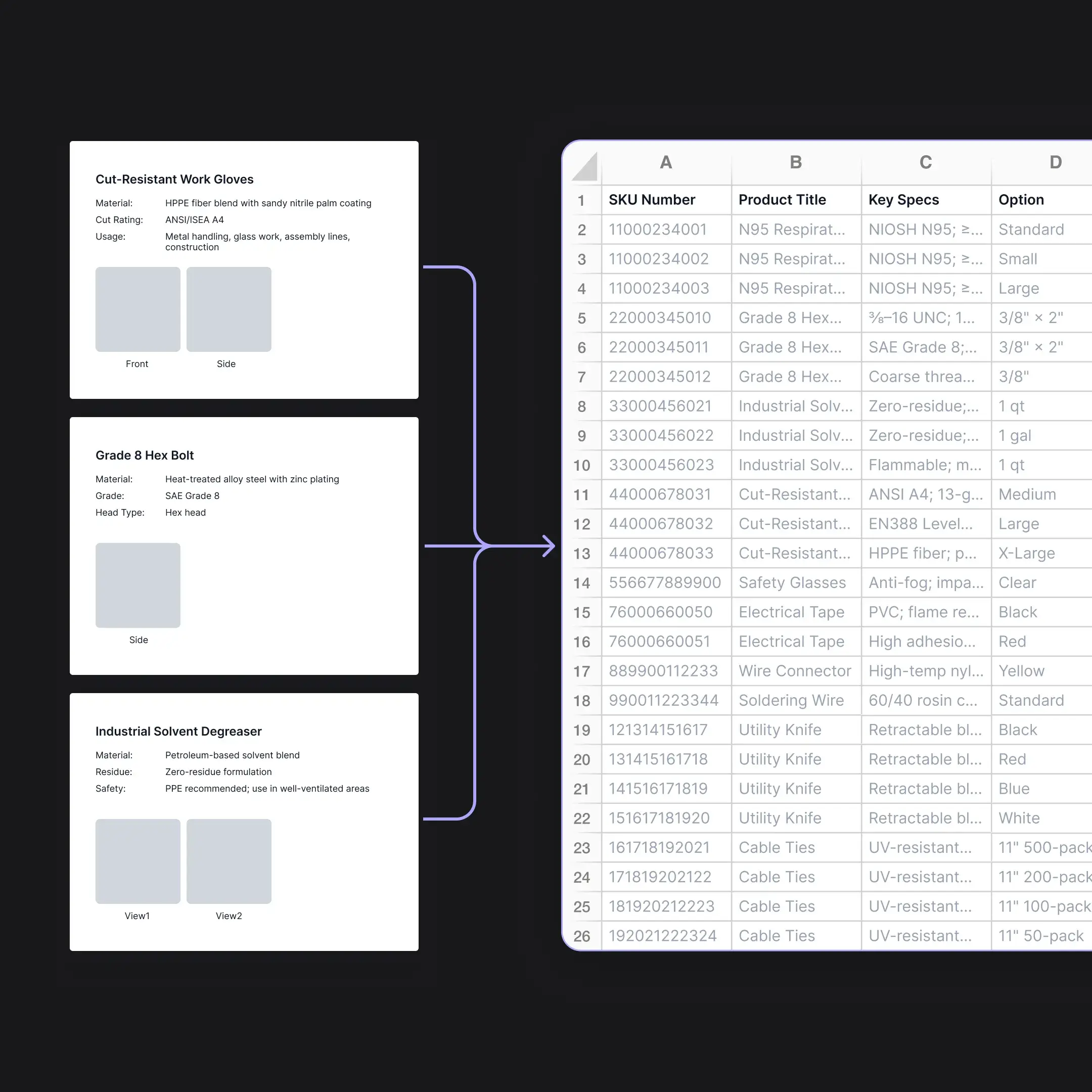
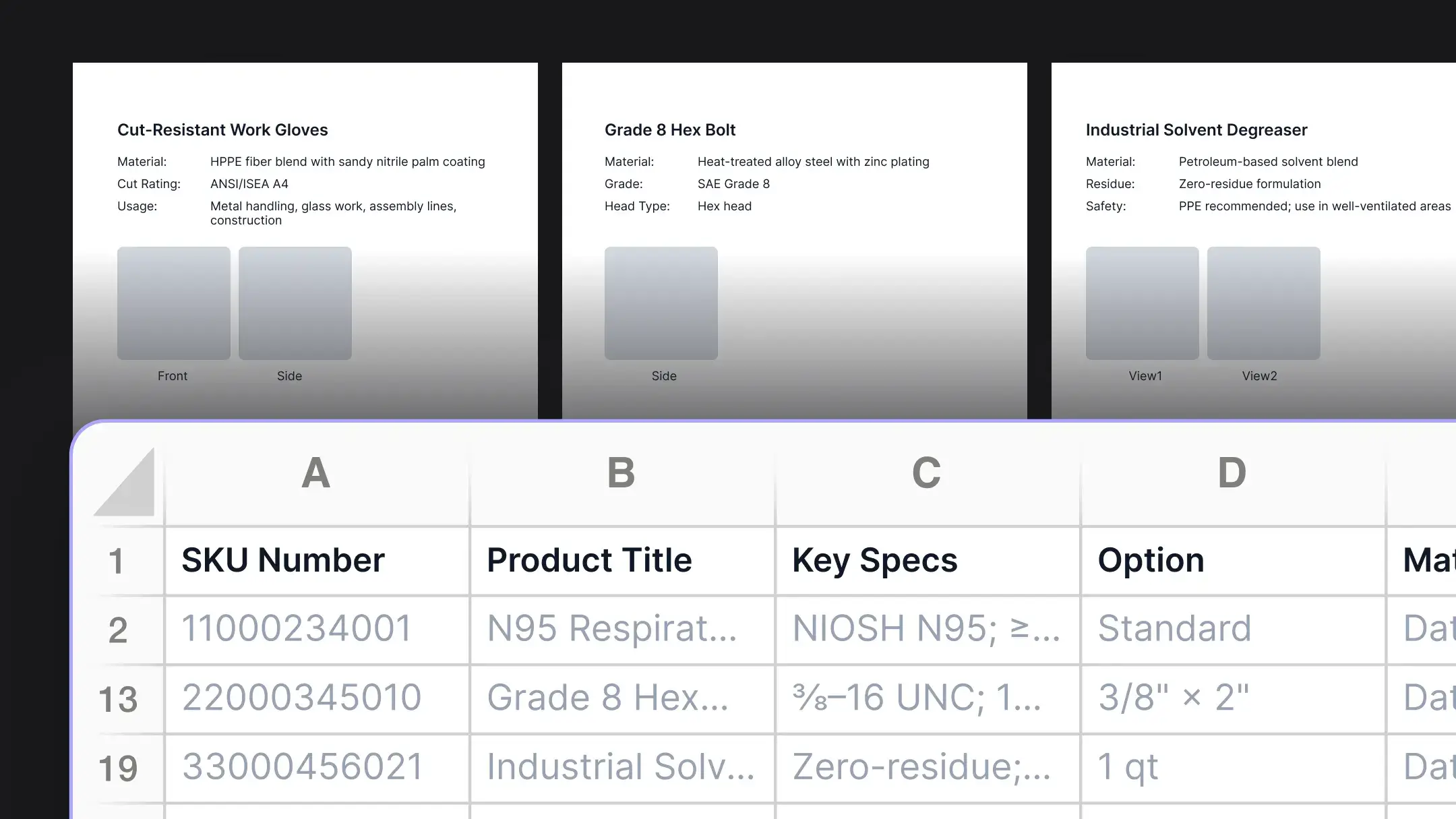









Onboard data from every manufacturer

Suppliers submit in the format they already use, through a portal, or your team uploads on their behalf.
Spreadsheets, PDFs, images and data feeds all come into the same place.
Suppliers work in their own space and never touch your live catalog.

Map and standardize to your attributes
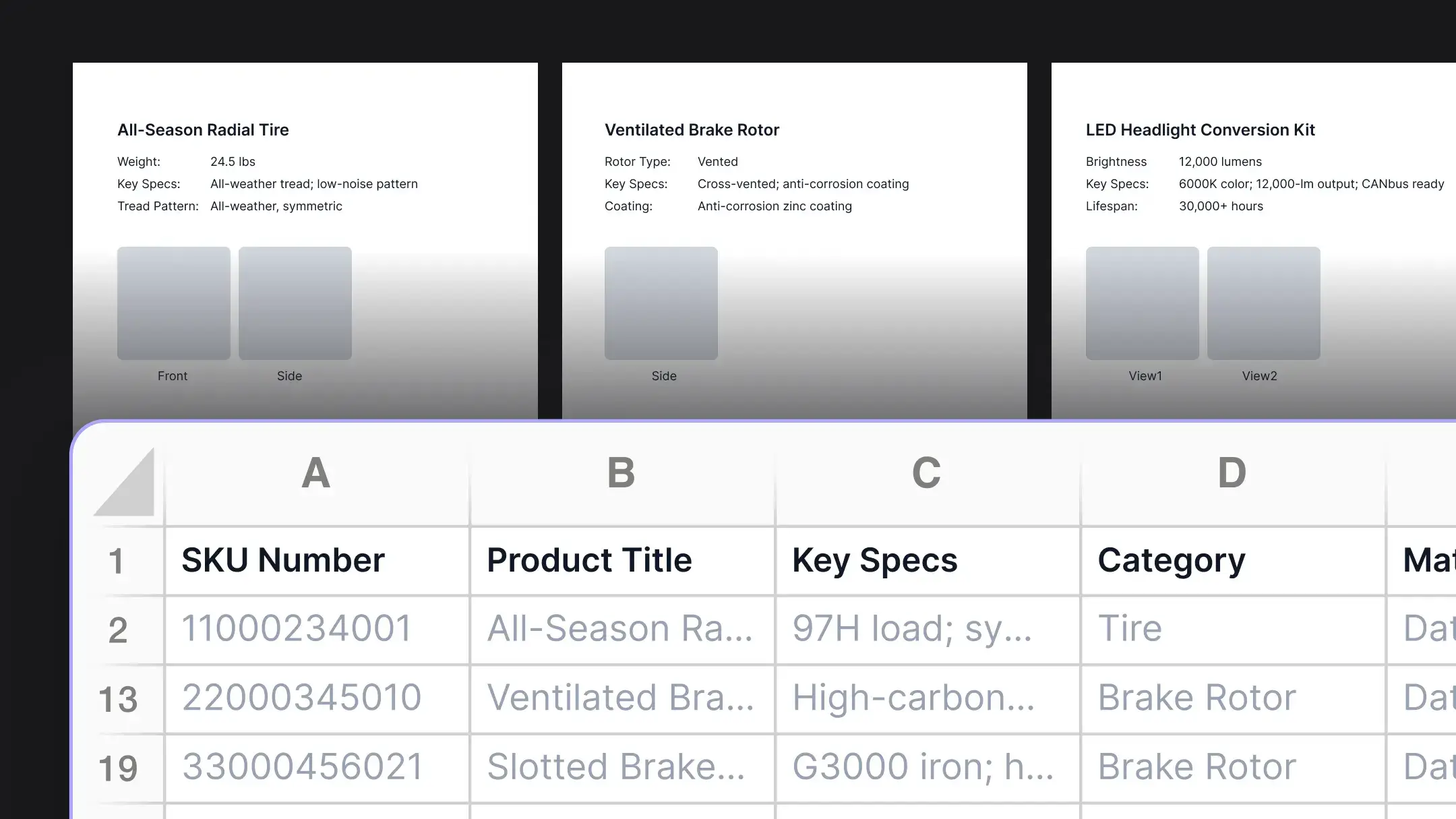
AI matches each manufacturer's fields to your attributes, such as "Current rating" to "Amperage".
Values are standardized to your units and conventions, so "20A" and "20 amps" become one value.
Variants are grouped into the right product families, and your team keeps override control on every value.
Fill in missing specs
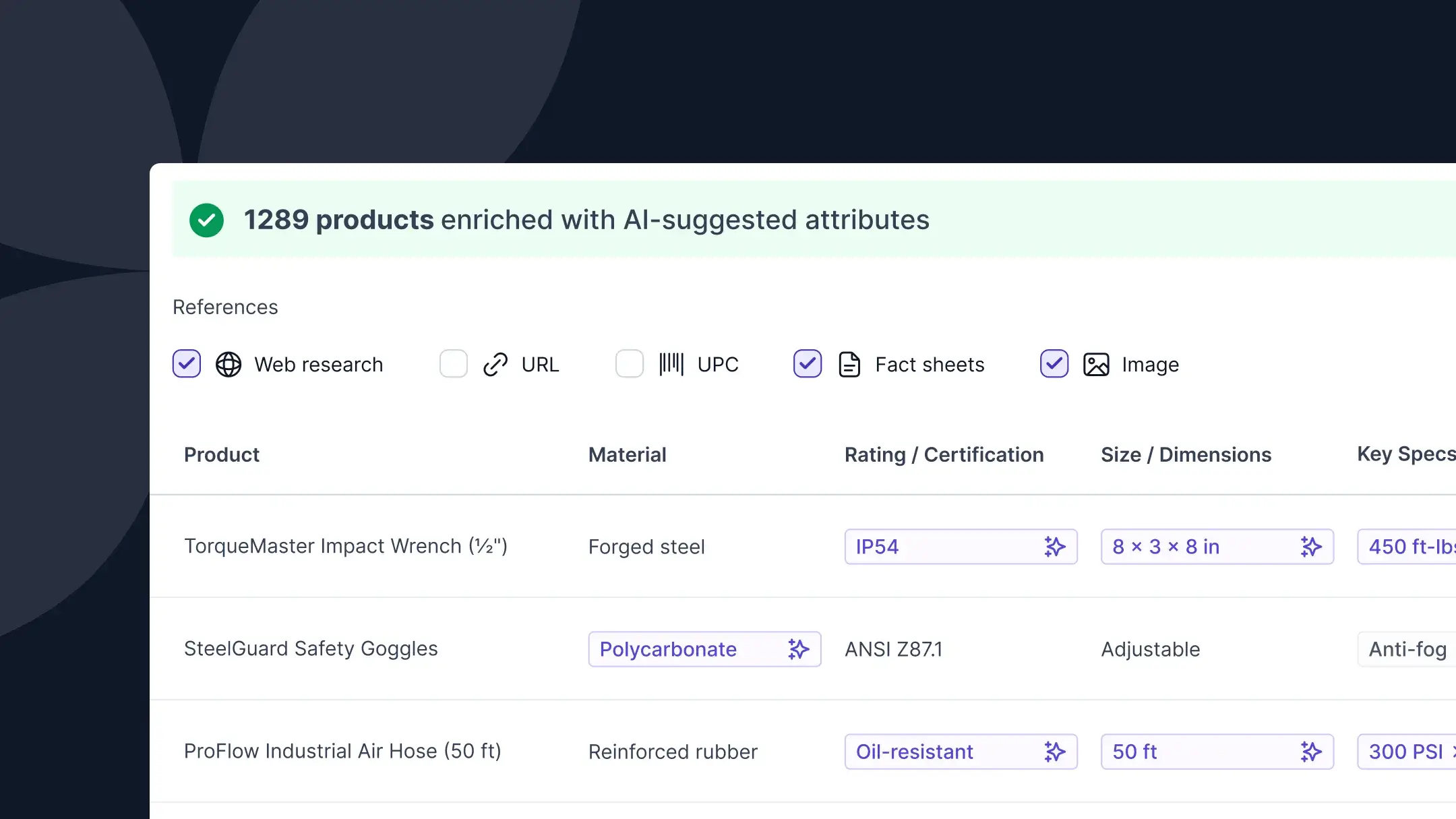
AI fills missing attributes from the web, UPCs, product images and manufacturer spec sheets.
Every suggested value is traceable to its source, so reviewers can check where it came from.
Your team approves values in bulk where it trusts them and inspects individually where it matters.
Classify every product into your taxonomy
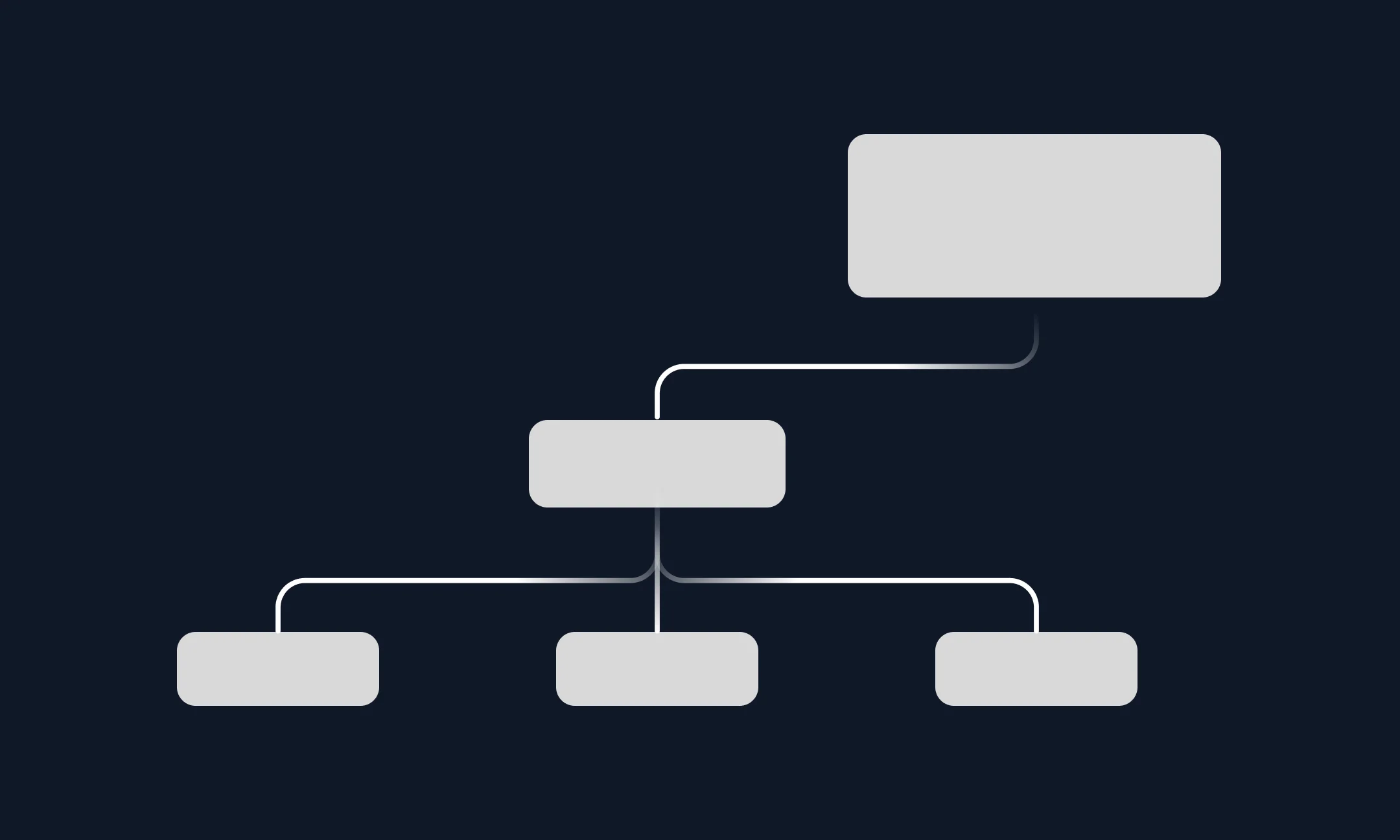
Products from every manufacturer are classified into your own category tree.
Attributes and tags are applied to match each category, so filters work across brands.
Your taxonomy can be mapped to marketplace category requirements.
Write listings at scale
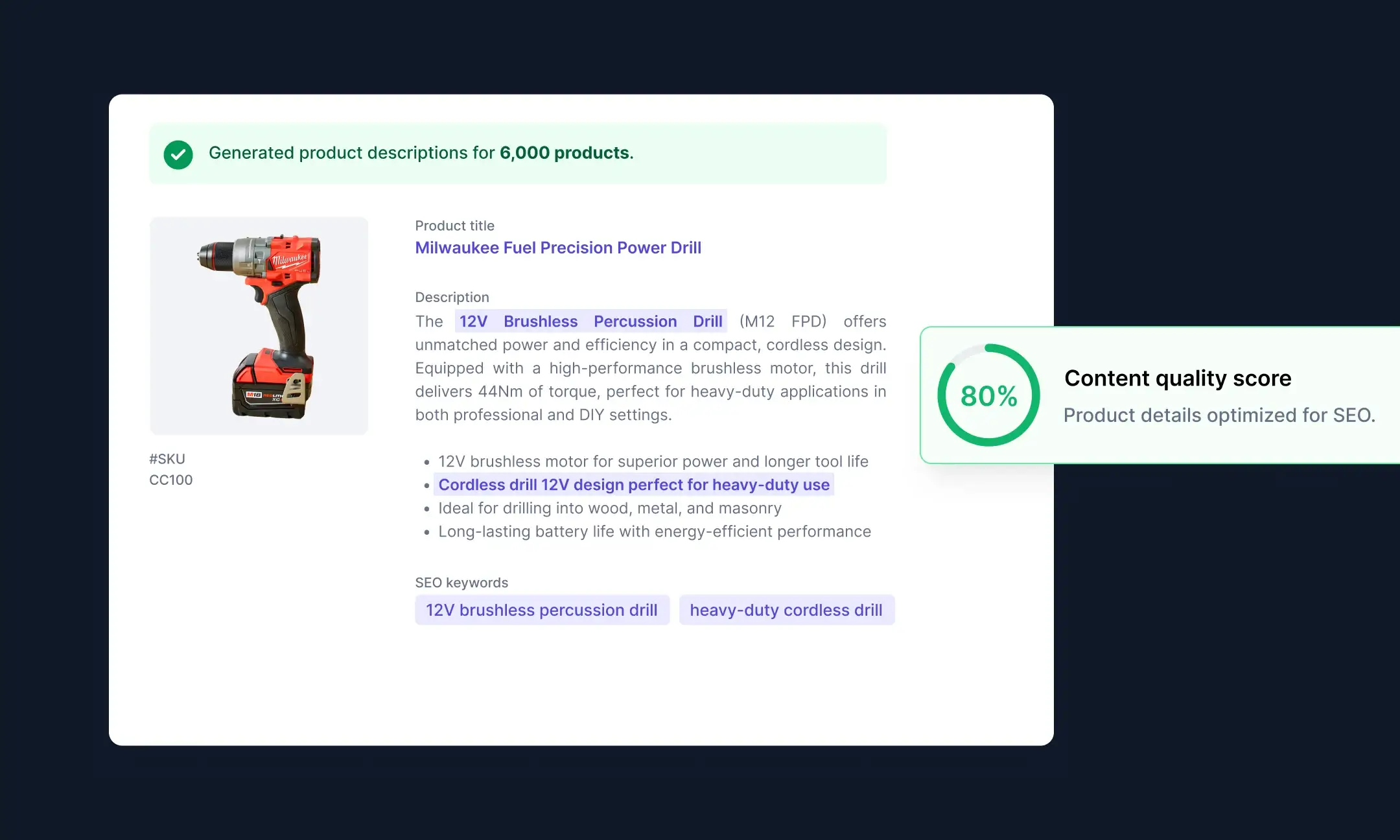
Titles and descriptions are written in bulk from each product's attributes, in your brand voice.
Copy follows your brand voice and style across every category and manufacturer.
Descriptions are written for SEO and GEO, so products show up in search and AI answers.
One platform, from manufacturer file to finished listing


Frequently Asked Questions
What is a PIM for distributors?

A PIM for distributors collects product data from every manufacturer a distributor carries, standardizes it to one set of attributes and units, fills in missing specs, and keeps one complete record per SKU for the website, print catalogs, sales team and customer service.
Why do distributors need a PIM?
Distributors carry products from hundreds of manufacturers, and each one sends data in its own format. Without a PIM, that data gets reformatted by hand for every new product, and the same attribute ends up written several ways, which breaks search and filters. A PIM standardizes it once, in one place.
Which distributors use Hypotenuse AI?
Distributors in any category that carry products from many manufacturers. Technical catalogs feel the problem most, because buyers filter and compare on detailed specs, but the same work applies to consumer goods. For example:
- Industrial and MRO supplies. Tools, fasteners, abrasives and safety equipment with detailed technical specs. See AI PIM for industrial supplies.
- Electrical, plumbing and HVAC. Ratings, dimensions, certifications and compliance labels that buyers filter on.
- Automotive parts. Fitment and compatibility data across makes and models. See AI PIM for automotive.
- Electronics and components. Specs and compatibility that buyers compare line by line. See AI PIM for electronics.
- Beauty and personal care. Ingredients, sizes, shades and claims from hundreds of brands. See beauty and personal care.
- Home and furniture. Dimensions, materials and finishes across many suppliers. See AI PIM for furniture.
How does product data enrichment work for distributors?
It fills in the specs a manufacturer didn't send and standardizes the ones it did. Take an electrical distributor carrying breakers from hundreds of manufacturers. One lists the rating as "20A", another as "Current rating: 20 amps", and a third sends only a PDF spec sheet. Without enrichment, a buyer who filters for 20 amp breakers may only see the products labeled one way.
Hypotenuse AI records the rating in one format across all three, and fills missing specs such as dimensions, ratings and compatibility from the web, UPCs, product images and spec sheets. Every value can be traced back to its source.
Can a PIM replace an ERP for distributors?
No. The ERP runs orders, inventory, pricing and purchasing. The PIM manages the product content buyers see, such as specs, descriptions, images and documents. Hypotenuse AI connects to your ERP, so SKUs and core data flow in without re-entry. See PIM vs ERP.
How is a PIM different from an ERP or spreadsheets for distributors?
| ERP | Spreadsheets | PIM | |
|---|---|---|---|
| Main job | Orders, inventory, pricing and purchasing | Quick edits and one-off lists | The product content buyers see |
| Product data it holds | SKU, price and stock, with few specs | Whatever each file contains | Full specs, descriptions, images and documents |
| Data from many manufacturers | Not designed for it | One file per supplier, each in its own format | Mapped and standardized to your attributes |
| Large catalogs | Handles volume, but not content | Hard to keep consistent across tens of thousands of SKUs | Built for it |
Do we need to replace our current PIM?
No. Hypotenuse AI can run as your PIM, or work alongside an existing one, onboarding and enriching the data that feeds it.
Can Hypotenuse AI handle a very large catalog?
Yes. It's built for high-volume, high-complexity catalogs, from a few thousand SKUs to millions, and enriches, categorizes, tags and writes content across the whole catalog.