





.svg)




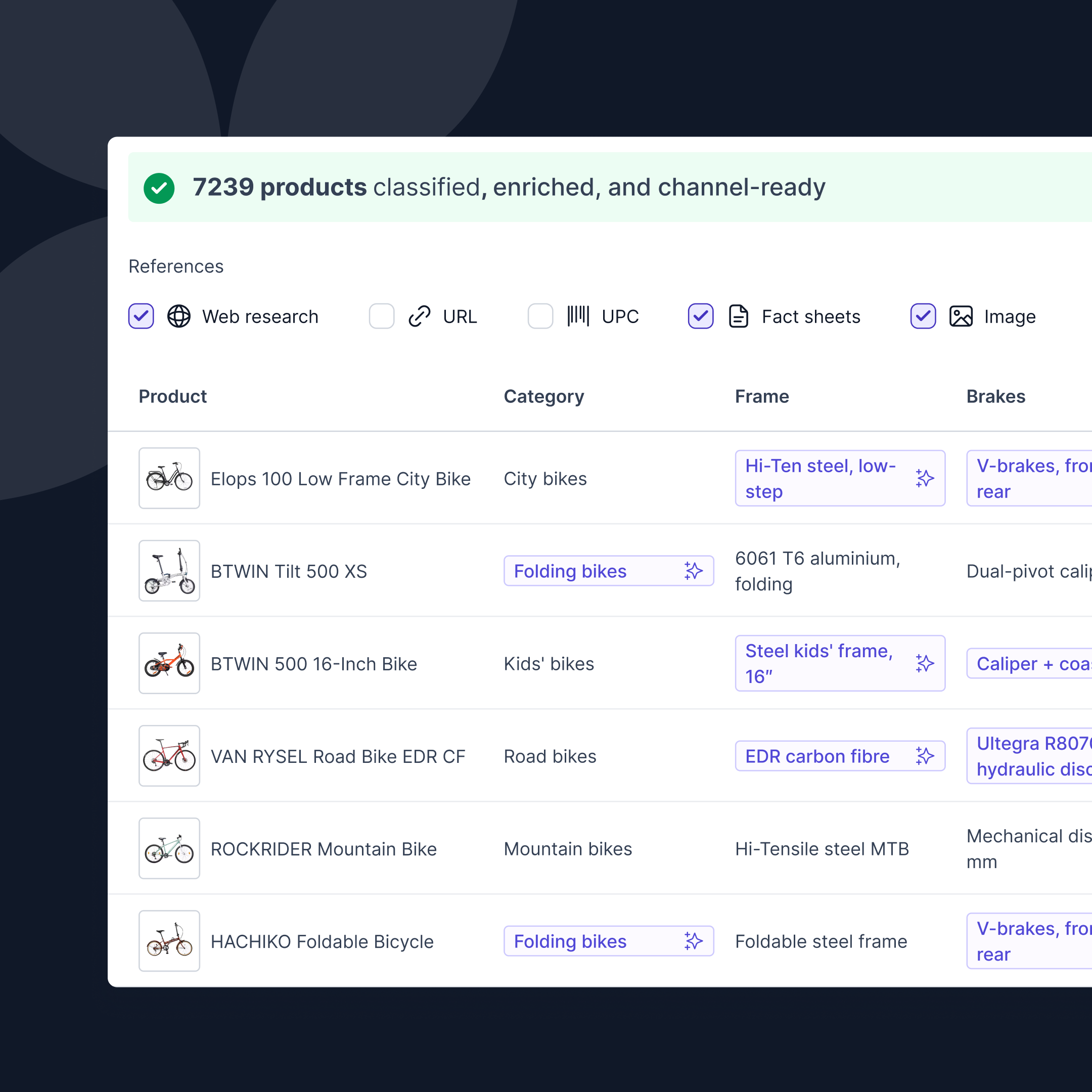
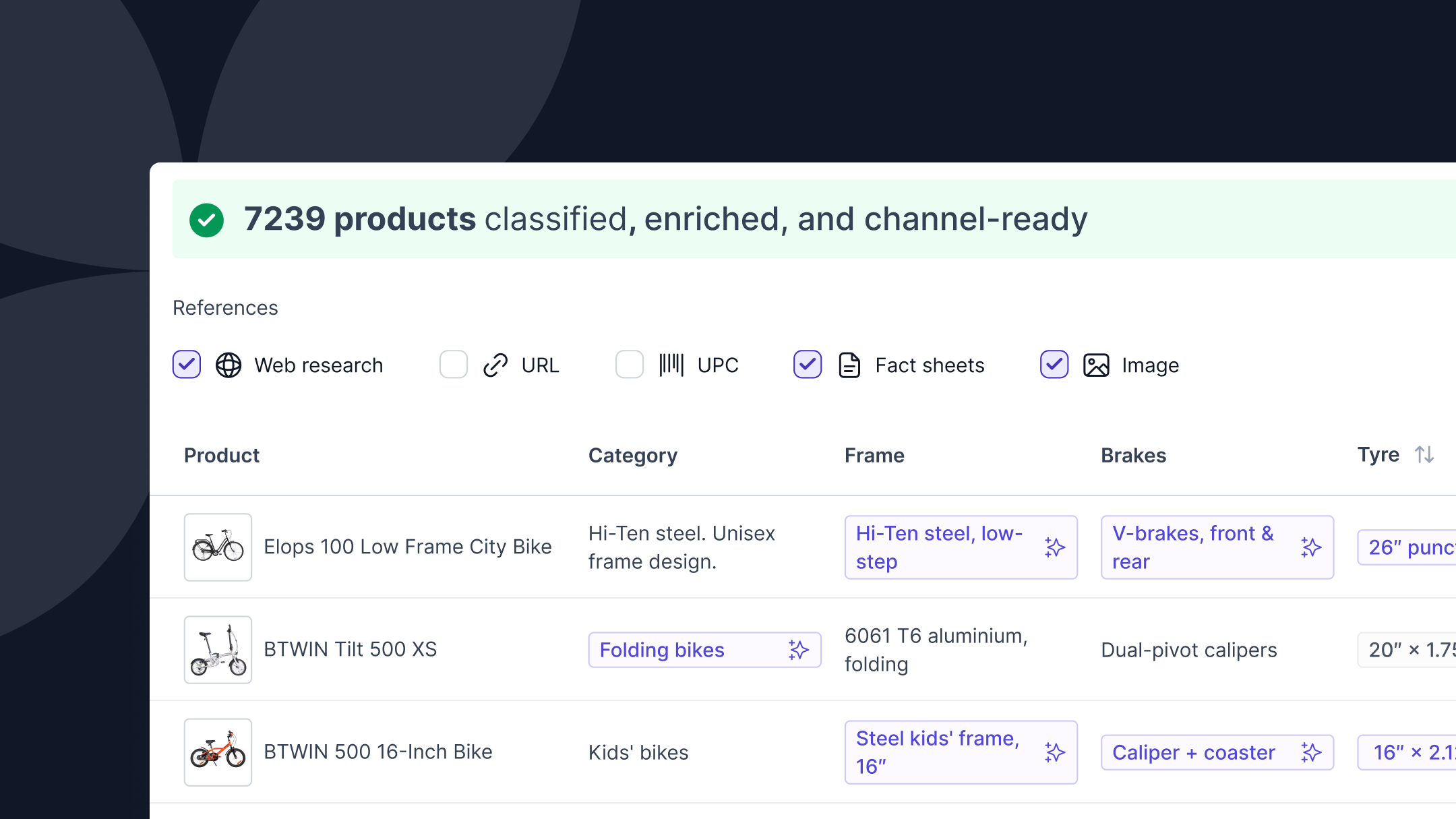
Catalog management software organizes, enriches, and maintains product information across an ecommerce catalog so it stays accurate and consistent everywhere it is published. It classifies products into a taxonomy, completes missing attributes, generates product content, and keeps every sales channel in sync as the catalog changes.
That work never stops. Every new supplier, channel, or regulation means something to re-check, and there is always a product out of date or missing a required field. Hypotenuse AI does it across the whole catalog: classifying every product, filling in what suppliers leave out, and producing the copy and images.
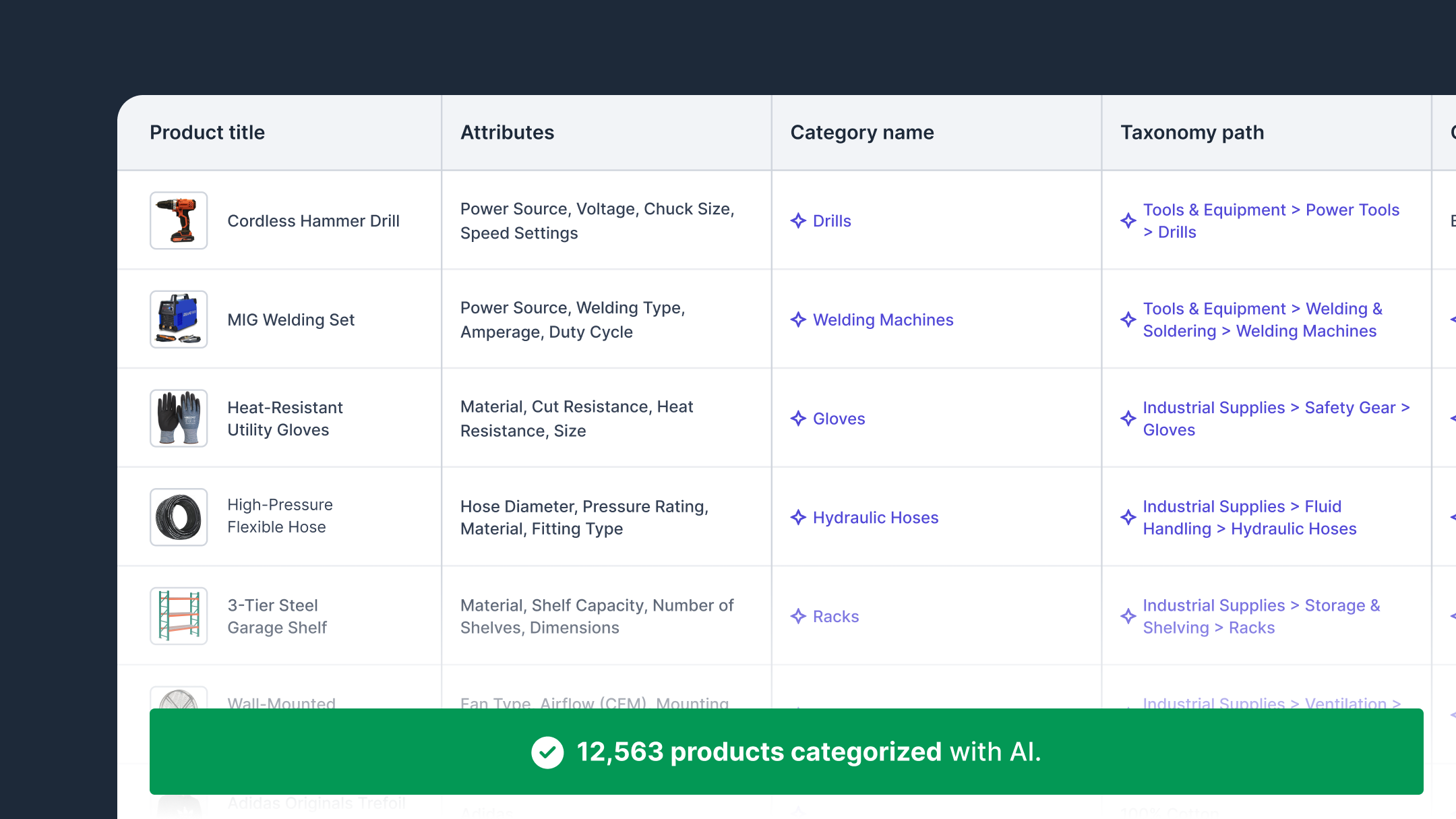
Classify every product correctly, and keep it that way

Auto-classify products into your taxonomy in minutes, even when the source data is incomplete or inconsistent.
Works with custom taxonomies and third-party formats (Google Shopping, marketplace taxonomies).
Adapts as your taxonomy changes, and keeps categories aligned across your PIM, CMS, and marketplaces.
Fill in what suppliers leave out
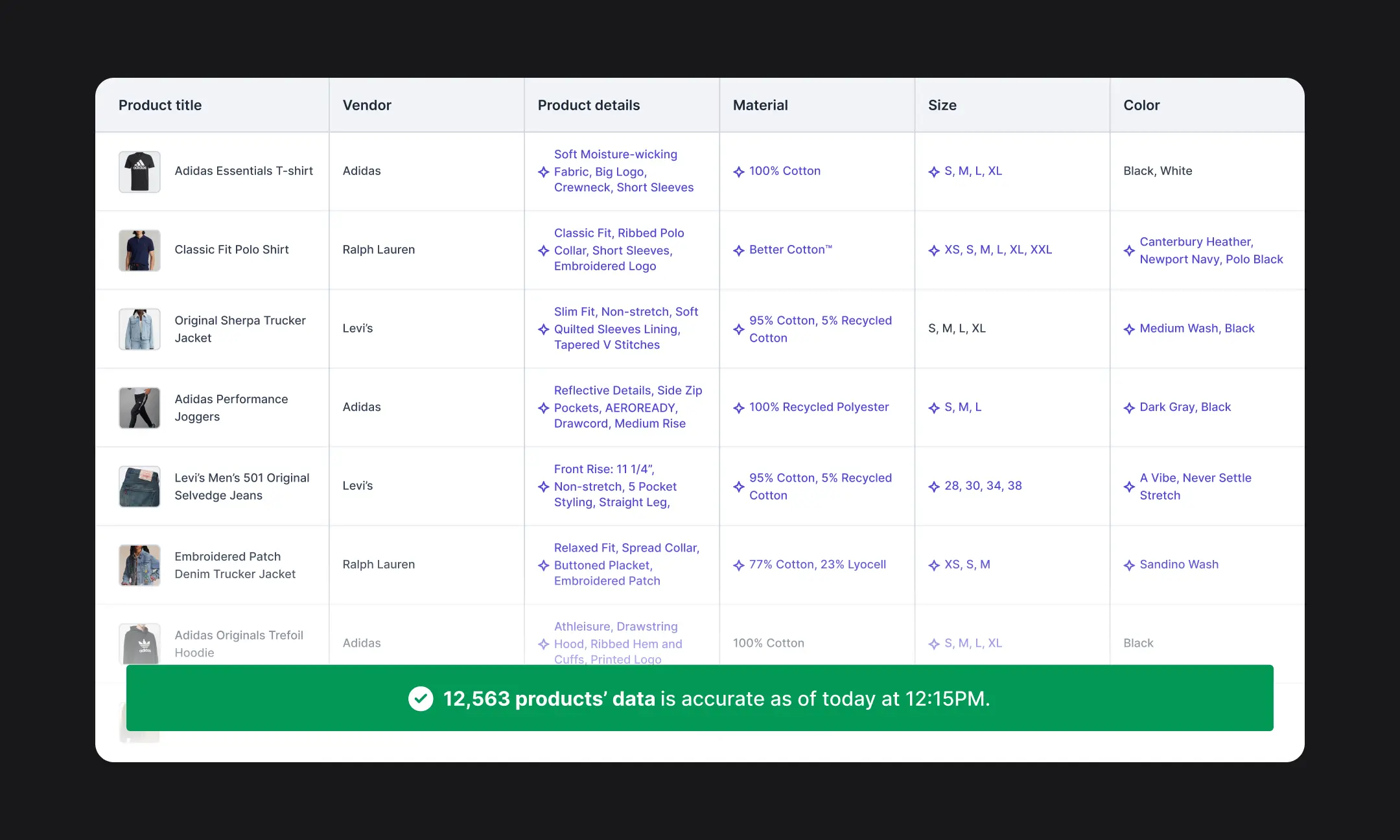
Pull product details from supplier feeds, emails, spreadsheets, PDFs, spec sheets, product images, UPC and EAN lookup, and the open web.
Harmonize inconsistent supplier data: correct spelling errors, unit variations, and misclassified attributes.
Standardize units and naming across the catalog, so "CM", "cm", and "centimeter" stop being three different things.
Every value traces back to its source, and anything uncertain is flagged for review before it publishes.
Write the content each product needs
On-brand descriptions, titles, and bullets, variant-aware, written from your own product data rather than reused from supplier copy.
SEO-optimized for Google and for marketplaces, and never duplicated across similar products.
Collection and category page copy, meta titles, and meta descriptions in the same brand voice.
Localize into 40+ languages for regional storefronts.

Get every product's images channel-ready
Source missing images by searching supplier portals and the web when what the vendor sent is incomplete.
Batch-edit thousands at once: background removal, cropping to spec, resolution enhancement.
Auto-flag images that miss a channel's requirements (background, dimensions, resolution, cropping), with standards configurable per retailer.
Generate SEO-optimized alt text and file names at catalog scale.

Keep it accurate and compliant as things change
Enforce data governance and formatting rules; validate fields against internal rules and channel requirements.
Roles, permissions, and approval workflows with visibility across product, marketing, and regional teams.
Versioning across catalog changes, so you can see what changed and when.
A full audit trail of the inputs behind every value, so anything can be traced to where it came from.

AI does the work. Your team makes the calls.


Built for teams running large catalogs


Proven across every industry
From fashion to pharmacy, wherever product data has to stay accurate at scale.
Frequently asked questions about catalog management software
What is catalog management software?

Catalog management software organizes, enriches, and maintains product information across an ecommerce catalog so it stays accurate and consistent everywhere it is published. It classifies products into a taxonomy, completes missing attributes, generates product content, and keeps every sales channel in sync as the catalog changes.
What is product catalog management?
Product catalog management is the ongoing work of keeping every product in your catalog correctly categorized, fully attributed, well described, and published accurately to every channel. Done by hand, it is limited by how many products your team can check. AI-native platforms like Hypotenuse AI run it as bulk operations, so the work is no longer capped by how many products a person can get through.
What is an ecommerce product catalog?
An ecommerce product catalog is the complete set of products a business sells online, together with the data that describes each one: category, attributes, images, descriptions, and channel-specific formatting. It is what powers category pages, filters, site search, and marketplace listings.
How is catalog management different from a PIM?
A PIM is the foundation: the data model, the single source of truth, and the governance around it. It is where product data lives and how it stays controlled. Catalog management is the work of filling it and keeping it right: classifying products, filling in what is missing, writing content, and publishing to channels. Hypotenuse AI has a PIM built in, so it can manage your product data directly. If you already run a PIM you want to keep, it works with that instead.
Can Hypotenuse AI handle a large catalog?
Yes. The limit on catalog work is usually human time, not software. Because classification, enrichment, and content generation all run as bulk operations with fast review, the work does not scale with the number of products the way manual checking does.
How is AI catalog management different from doing it by hand?
Doing it by hand, the limit is how many products a person can check in a week, and that limit does not move. AI does the first pass across everything and your team reviews the exceptions. Task by task:
| Catalog task | By hand | Hypotenuse AI |
|---|---|---|
| Categorizing products | Check each one, or rules that break the moment the data is messy | Auto-classified into your taxonomy in minutes, even from messy data |
| Missing product details | Chase suppliers, then normalize whatever comes back across emails, spreadsheets, and PDFs | Pulled from images, spec sheets, feeds, and the web, with every value traceable to its source |
| Inconsistent supplier data | Cleaned up by hand on every import, and the errors that slip through surface after they are live | Units, naming, and classifications harmonized on the way in |
| Product and category content | Reusing supplier copy that dozens of other distributors already use | Written from your product data, in your brand voice, SEO-ready, never duplicated |
| Staying accurate and compliant | Relying on memory and spot checks | Validation rules, approval workflows, versioning, and a full audit trail |
| What limits you | Human time. Only so many products can be checked in a week. | Bulk operations, with people reviewing what needs judgment |
How do you keep AI-generated catalog data accurate?
Anything the AI is unsure about is flagged for review rather than published quietly. It cross-checks multiple sources, enriched values stay marked and editable, and every value can be traced back to the input it came from, so you can always see why a value is what it is.
.webp)


.avif)