When a shopper asks an AI assistant whether a filter fits their air purifier or whether a slipcover fits their sofa, the answer depends on a relationship between two products.
Product compatibility data records which products fit, work with, replace or are used up by other products. This guide covers the relationships worth modeling and how to store them as structured fields. It also covers where the data comes from and how to check it before it reaches a channel. The same questions come up in furniture, beauty, fashion and home goods, wherever one product depends on another.
Why do AI assistants get fit and compatibility questions wrong?
AI assistants get these questions wrong because most catalogs don't store compatibility as data. It usually sits in descriptions and PDF manuals, where a model has to read it and guess. To answer reliably, a model needs a stated relationship: this product works with that product, under these conditions. The companies building AI shopping tools point to the same gap.
In November 2026, Reuters reported on an internal Amazon document (which Amazon said was outdated) describing a planned World Product Graph, a database meant to cover items well beyond Amazon's own catalog. The document said many answers from Amazon's shopping assistant were factually wrong or incomplete. The document named an understanding of how products relate to each other as what had been missing.
Google is moving the same way. Merchant Center's related_product attribute, one of its conversational attributes for AI-driven shopping, lets merchants state in their feed which items are accessories or required parts for a product.
Suggestions carry the same risk. Baymard Institute's usability research on compatibility found that many shoppers assume a product shown next to another one works with it, and they read an AI assistant's suggested add-ons the same way.
If two products are linked only because people often buy them together, an assistant may recommend one as compatible with the other. When it doesn't fit, the shopper ends up with a product they can't use, which makes for a poor experience.
Which product relationships should you model?
Each relationship type answers a different shopper question. Store them as separate types so a channel or assistant can tell a required refill apart from an optional upgrade.
| Relationship | What it records | Example |
|---|---|---|
| Fits | Product A physically fits product B under stated conditions. | A slipcover made for a specific sofa model. |
| Works with | Product A works with product B through a technical standard rather than a physical fit. | A thermostat that supports a given heat pump control protocol. |
| Replaces | A newer part number takes over from an older one for the same job. | A reformulated serum that replaces a discontinued one under a new product code. |
| Accessory | An optional add-on that extends the main product. | Interchangeable straps for a handbag. |
| Consumable | An item used up and replenished during normal use. | Pods for a coffee machine. |
| Required part | An item the main product needs in order to work. | Batteries for a toy that ships without them. |
| Newer model | The next generation in the same product line. | This season's version of a running shoe. |
Direction matters. An accessory points to the product it serves, and a replacement points from the new part to the old one. A substitute is a different product that can be used in place of the original. A replacement is the original's official successor. Keep these as distinct types.
Automotive is the most developed version of this problem, with fitment recorded against year, make, model and engine using dedicated industry standards. Retailers of auto parts and accessories treat fitment as its own data discipline, and the same thinking extends to every category where one product depends on another.
How should you store product relationships?
Most catalogs store compatibility in one of two weak ways: as text in the description, or as a generic "related products" link. Shopify, for example, gives each product two lists of linked products, related and complementary, with no way to say whether a linked item fits or is only an optional extra.
A stronger setup gives each product a list of linked products, and each link a type that says what it means. Here is how that looks for a replacement filter for an air purifier.
| Linked product | Relationship type |
|---|---|
| The air purifier, by its GTIN | Consumable |
| A pre-filter pack | Accessory |
Most PIMs support this kind of list. Many also show the link from the other side, so the purifier's record lists the filter as its refill without anyone entering it twice. Where the fit depends on something like a production date, add it as an optional detail on the link, such as "units made from 2024 onward, per the manufacturer's manual".
Write each link against the other product's identifier, such as its GTIN or SKU. "Fits most 200-series purifiers" in a description can't be matched to anything.
There are two ways to fill in these links.
Explicit pairs
Some manufacturers list exactly which products fit. If an air purifier's manual says it takes filters F-210 and F-215, you record two relationships: the purifier with F-210, and the purifier with F-215. You copy the manufacturer's list instead of working out the fit yourself.
Attribute matching
Use this when a measurement decides the fit. A slipcover made for three-seat sofas 180 to 200 cm wide fits any sofa in that range. You store the seat width on both products and match them, so you don't have to list every sofa model.
This only works when both products hold the value in the same field and the same unit. When suppliers send seat width as "Seat W", "Width (in)" and "Sofa size", AI attribute mapping maps them into one field and standardizes the values.
Prose still has a place. Descriptions and FAQs can explain compatibility in plain language, and they should be generated from the structured record so that the text and the data say the same thing. The record is the source, and the sentence is how it reads on the page.
Where does compatibility data come from?
Most compatibility data already exists in documents that sit outside the catalog.
- Spec sheets list the deciding attributes, such as dimensions, connectors, voltages and thread sizes.
- Manuals carry compatible model tables, parts diagrams and consumable part numbers.
- Supplier files include cross-reference sheets and supersession lists that map old part numbers to new ones.
- Packaging and labels state model ranges and standards supported.
- Return reasons and support tickets point to relationships that are missing or wrong, and they work best as a queue for review rather than as a source of new links.
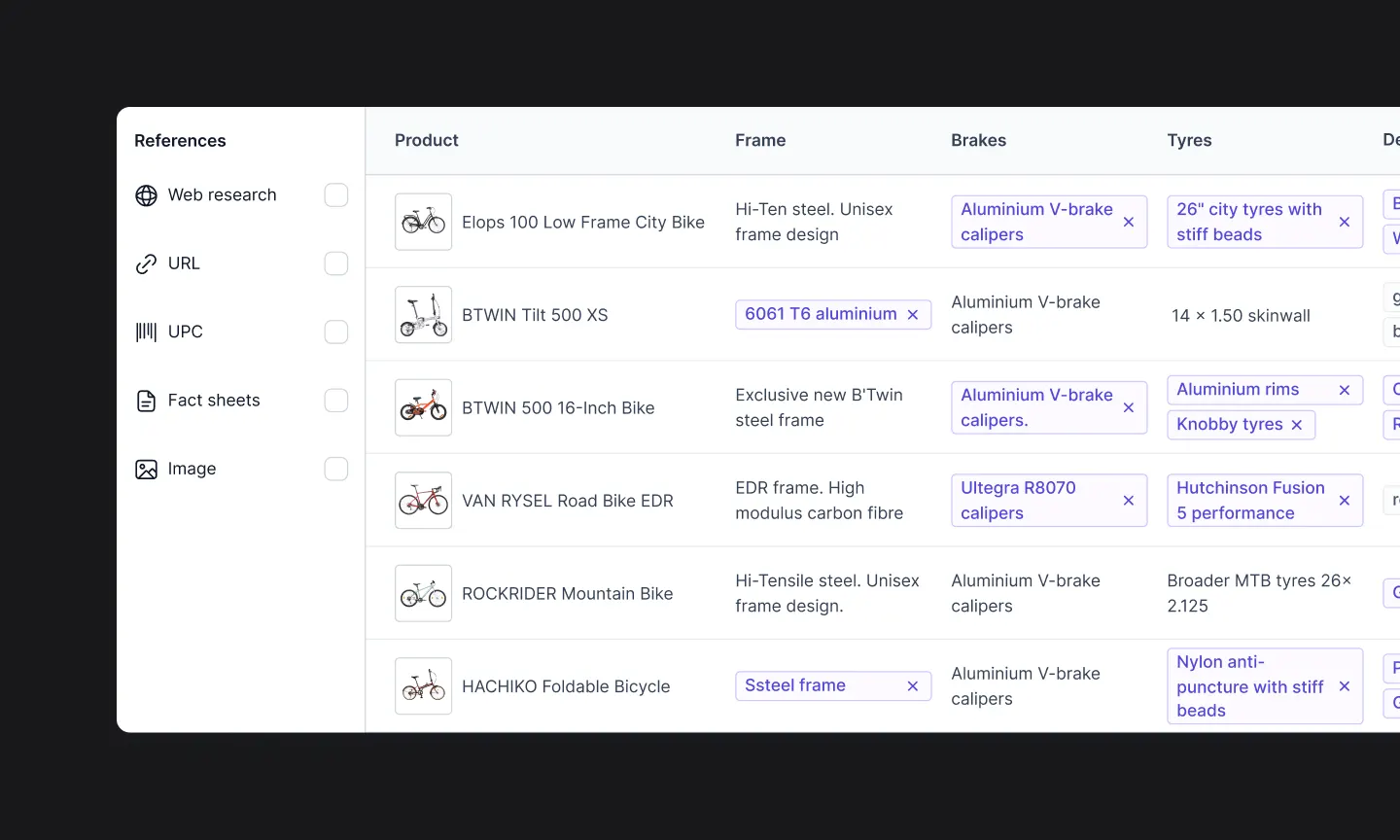
The work is getting these values out of documents and into fields. Hypotenuse AI's ecommerce product data enrichment can read a product's spec sheet or PDF manual and copy details like a filter's size or a sofa's seat width into the right product fields.
How do you check relationship data before it goes live?
Before relationship data reaches a channel, check that each relationship still points somewhere real and still holds.
- Both products in a relationship still exist and are active. A filter linked to a purifier you no longer sell sends shoppers nowhere.
- No product is linked to itself, and no pair is marked as two conflicting types at once.
- When a discontinued part points to its replacement, the replacement is still sold. If ink cartridge 100 was replaced by 100A, and 100A was later replaced by 102, a shopper asking about cartridge 100 should be shown 102.
- The deciding measurement matches on both sides, for example the same seat width in the same unit.
- Where you record a source, it names the document and when someone last checked it.
- New products get their accessory and refill relationships before launch.
- The categories with the most "doesn't fit" returns get a sample check each cycle.
How do you send product relationships to AI shopping channels?
Channels are starting to accept relationship data directly. Google Merchant Center's related_product attribute links a product to up to 30 related items. Each link has a relationship type, an identifier type (GTIN or your own product ID) and the identifier. The attribute is optional and available in all countries.
Google supports six relationship types: part of set, required part, often bought with, substitute, different brand and accessory.
Relationships reach Google through your Merchant Center product feed, in the related_product attribute. Most teams export it from their PIM or ecommerce platform, or add it with a supplemental feed.
Each relationship needs one of these six types. An accessory or a required part has a matching type, so it goes across as it is. A "fits" or "replaces" relationship has no match, so you'd send it as the closest type, such as accessory, or leave it out.
The attribute is one of several Google Merchant Center conversational attributes built for AI-driven shopping surfaces. A clean internal relationship model lets you fill it from data you already hold, and reuse the same records for site search, filters, recommendations and PDP content.
FAQ
What is the difference between a replacement part and a substitute?
A replacement is the official successor to a part, usually a new part number from the same manufacturer that supersedes the old one. A substitute is a different product that does the same job, often from another brand. Store them as separate relationship types, because a shopper asking for the replacement wants the successor, not an alternative.
What is the difference between fitment data and product attribute data?
Attribute data describes the product itself, such as size, material or voltage. Fitment and compatibility data describe the product's relationship to another product, such as the machines a filter fits. Attributes often decide compatibility, so both need to be structured, but they live in different parts of the data model.
What PIM solutions help manage product hierarchies and variants?
Look for a PIM where hierarchies, variants and relationships are part of the data model rather than free-text fields, with validation before publishing. Hypotenuse AI's AI PIM solution lets you define product hierarchies, variants and relationships with flexible data models, and it enriches and validates attributes across the catalog.
Hypotenuse AI is an AI-first PIM and product content platform for enterprise ecommerce brands, retailers and distributors. Book a demo to see how it structures, enriches and validates the attributes your compatibility data depends on.